


Yes, an anxiety medication that doesn't cause weight gain exists, and several options carry little risk. A 2024 Annals of Internal Medicine study of 183,118 patients linked bupropion to the least weight gain, and fluoxetine matched sertraline. Buspirone lists weight gain only as an infrequent adverse event on its FDA label. A prescriber still weighs each drug against your symptoms.
Key Takeaways
- Bupropion, fluoxetine, and buspirone show the smallest weight signals in the sources reviewed here.
- Paroxetine and mirtazapine carry label or study evidence of weight gain.
- Bupropion is not FDA-approved for anxiety disorders, so prescribers use it for anxiety with depression.
- Weight effects differ between people, and the studied differences between common antidepressants are small.
- Never stop an anxiety medication abruptly because of weight; talk to your prescriber first.
What Is an Anxiety Medication That Doesn't Cause Weight Gain?
An anxiety medication that doesn't cause weight gain is a drug with a low weight signal, like buspirone, bupropion, or fluoxetine. Each works differently, so the right choice depends on the anxiety type and any depression alongside it. The drug must still treat the anxiety first.
The National Institute of Mental Health (NIMH) reports that 19.1% of US adults had an anxiety disorder in the past year. Our weight-conscious prescribing visits start by matching the drug to the diagnosis, then checking the weight record.
The table below shows the weight signal and FDA anxiety status for the main options.
| Medication | Class | Weight signal | FDA anxiety status |
|---|---|---|---|
| Bupropion (Wellbutrin) | Dopamine-norepinephrine reuptake inhibitor | Lowest gain in 2024 study | Not labeled for anxiety |
| Fluoxetine (Prozac) | SSRI | Similar to sertraline | Panic disorder labeled |
| Buspirone | Azapirone anxiolytic | Weight gain infrequent on label | Anxiety disorders labeled |
| Escitalopram (Lexapro) | SSRI | No clinically important change in trials | Generalized anxiety labeled |
| Hydroxyzine | Antihistamine | No weight warning on label | Short-term anxiety relief labeled |
Escitalopram appears in the table because its label reports no clinically important body weight change against placebo. The 2024 study found a slightly higher six-month gain, so the two sources point in different directions. Buspirone comes next because it has a different mechanism.
Does Buspirone Cause Weight Gain?
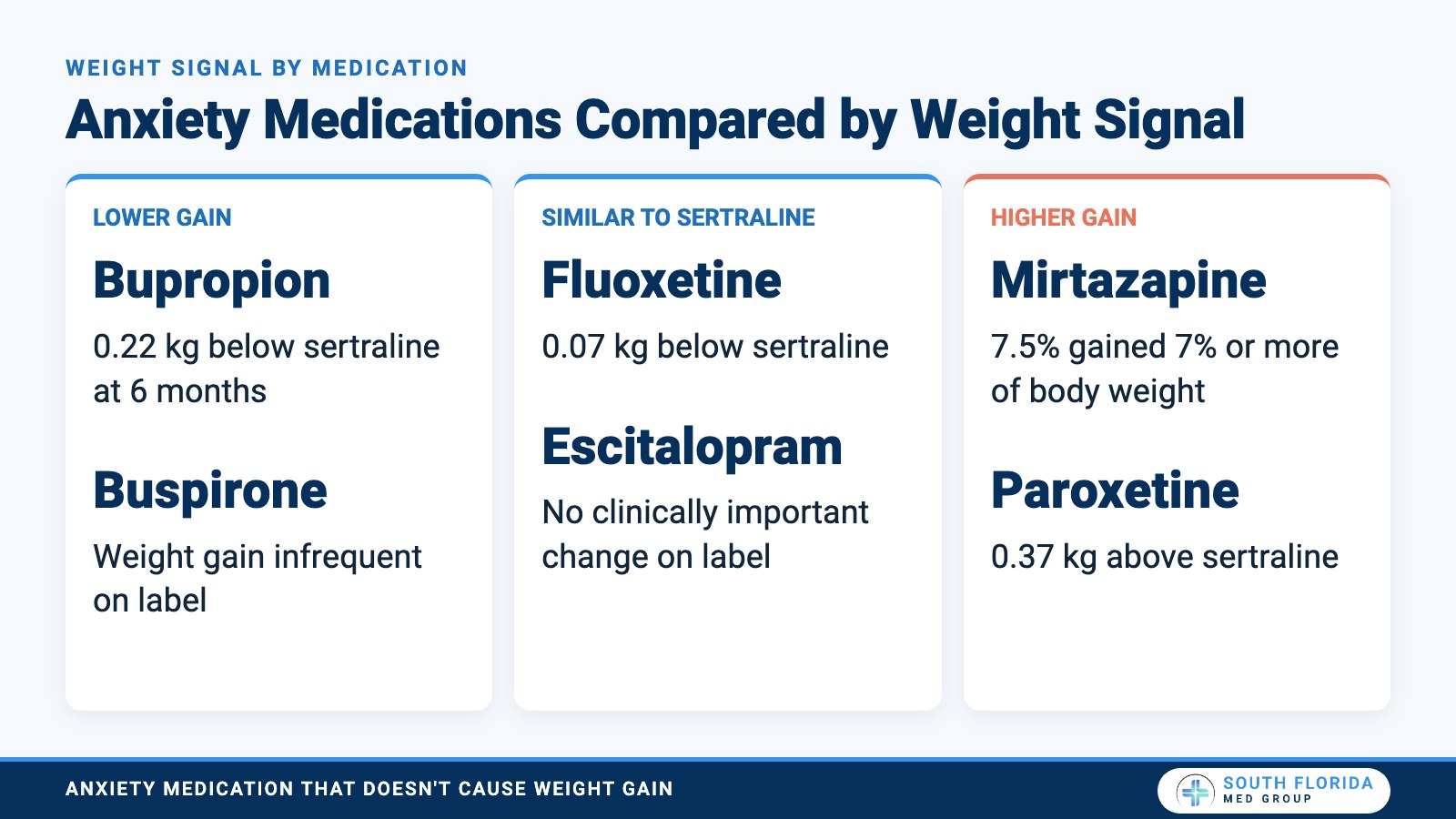
Buspirone lists weight gain only as an infrequent adverse event, so its label does not flag weight as a main concern. The FDA label also lists weight loss as infrequent. Buspirone is indicated for the management of anxiety disorders.
The label describes buspirone as less sedating than other anxiolytics and unrelated to benzodiazepines or barbiturates. The recommended initial dose in the label is 15 mg daily, given as 7.5 mg twice a day. That figure is a typical label range, not a recommendation for any patient.
Buspirone fits generalized anxiety, while bupropion fits a different pattern, so the next heading covers bupropion.
Does Bupropion Cause Weight Gain, and Does It Treat Anxiety?
Bupropion does not typically cause weight gain, and the FDA does not label it for anxiety. The Wellbutrin label lists major depressive disorder and prevention of seasonal affective disorder as its indications.
The Wellbutrin SR label reports weight changes in depression trials. At 300 mg per day, 14% of patients lost more than 5 pounds, against 6% on placebo. Gaining more than 5 pounds occurred in 3% on bupropion and 4% on placebo.
The 2024 Annals study agrees: bupropion was 0.22 kg lower than sertraline at six months. Bupropion also carried a 15% reduced risk of gaining at least 5% of baseline weight. A prescriber may add bupropion when anxiety and depression occur together, which links to the next question about fluoxetine.
Does Fluoxetine Cause Weight Gain?
Fluoxetine does not cause meaningful weight gain in the studies reviewed here. The 2024 Annals study found fluoxetine similar to sertraline at six months, with a difference of -0.07 kg.
The Prozac label reports weight loss in 1.4% of patients on fluoxetine, against 0.5% on placebo, in depression trials. The label warns that significant weight loss can occur, especially in underweight patients. Prozac is labeled for panic disorder, so it covers one anxiety condition directly.
Fluoxetine is an SSRI. The NIMH lists SSRIs and SNRIs as the usual starting point for panic and social anxiety because they cause fewer side effects. The next heading widens the lens to the whole drug group.
Do All Anxiety Meds Cause Weight Gain?
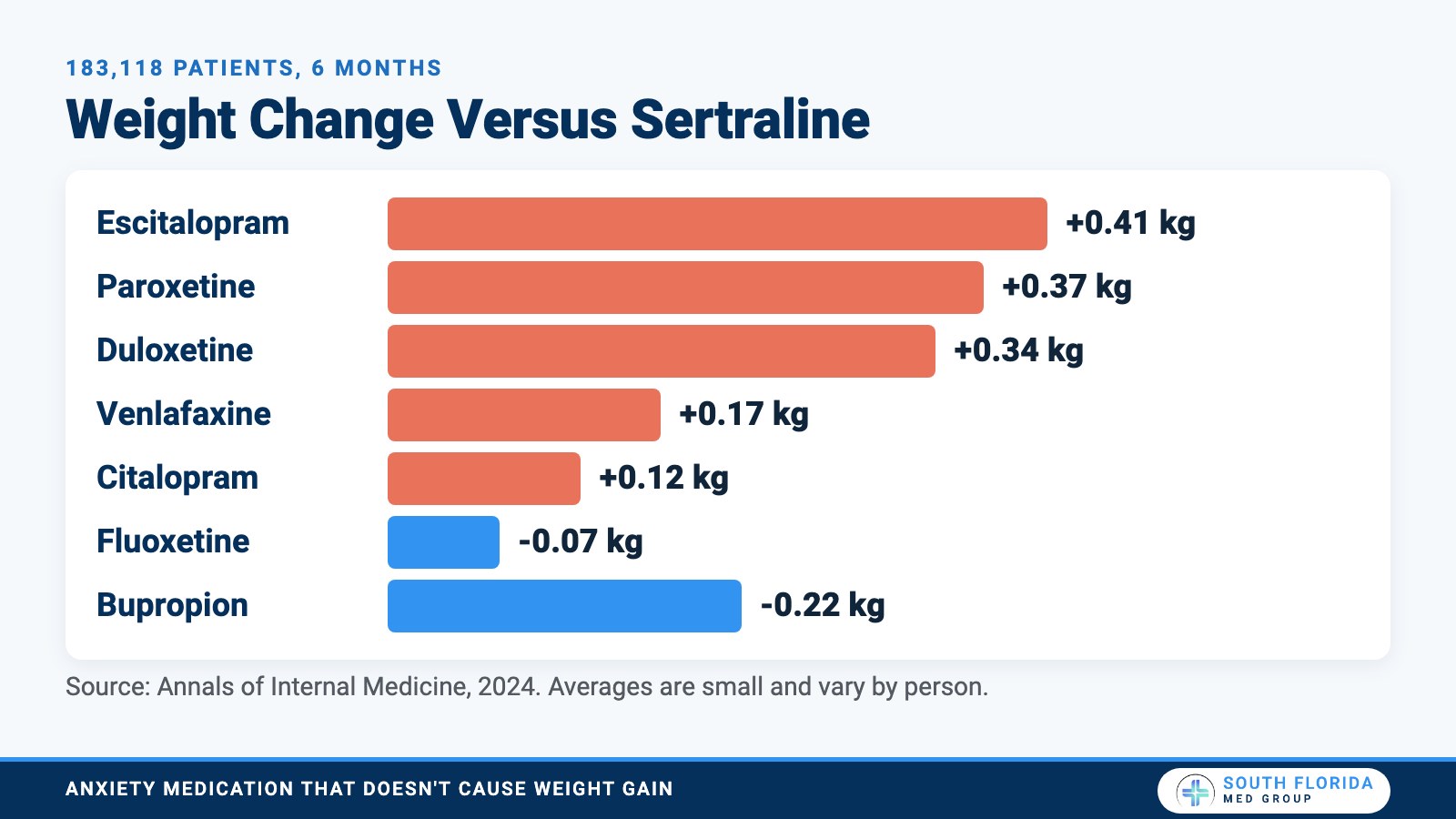
No, not all anxiety medications cause weight gain. Weight effects vary by drug, dose, duration, and person. The 2024 Annals study compared eight antidepressants and found small differences in mean weight change.
Against sertraline at six months, the study measured the differences listed below.
- Escitalopram: 0.41 kg higher.
- Paroxetine: 0.37 kg higher.
- Duloxetine: 0.34 kg higher.
- Venlafaxine: 0.17 kg higher.
- Citalopram: 0.12 kg higher.
- Fluoxetine: 0.07 kg lower, a similar result.
- Bupropion: 0.22 kg lower.
A 2025 Lancet network meta-analysis of 30 antidepressants and 58,534 participants also found clinically significant weight differences between drugs. Median treatment lasted only 8 weeks, so long-term gain needs separate study. The next section names the drugs with the clearest gain signals.
Which Anxiety Medications Cause Weight Gain?
Mirtazapine and paroxetine carry label evidence of weight gain among antidepressants linked to anxiety care. Mirtazapine (Remeron) is an antidepressant labeled for major depressive disorder. Paroxetine (Paxil) is labeled for generalized anxiety and several other conditions.
The Remeron label reports weight gain of 7% or more of body weight in 7.5% of patients, against 0% on placebo. Appetite increased in 17% of patients, against 2% on placebo. Eight percent of patients in a pooled set of studies discontinued for weight gain.
The Paxil label lists weight gain as a frequent adverse reaction. In the 2024 study, paroxetine averaged 0.37 kg more than sertraline at six months. The table below summarizes the drugs with gain evidence.
| Medication | Evidence | Source |
|---|---|---|
| Mirtazapine (Remeron) | 7.5% gained 7% or more body weight, against 0% on placebo | FDA label |
| Paroxetine (Paxil) | Weight gain listed as frequent; 0.37 kg above sertraline | FDA label and 2024 study |
| Duloxetine (Cymbalta) | 0.34 kg above sertraline at six months | 2024 study |
| Escitalopram (Lexapro) | 0.41 kg above sertraline at six months | 2024 study |
The gaps between these drugs are small on average, so each person's own weight record matters more. Understanding the mechanism explains why drugs differ.
How Much Weight Can Anxiety Medication Cause You to Gain?
Average gains are small, under 1 kg at six months in the 2024 Annals study of 183,118 patients. The escitalopram gap measured 0.41 kg versus sertraline. Individual patients can differ from these averages in either direction.
The Remeron label shows how larger effects look. In its trials, 7.5% of patients gained 7% or more of body weight. A 7% gain equals 14 pounds for a person who weighs 200 pounds.
Weight is one data point among several. Ongoing signs for adjustment include side effects, symptom control, and weight trends. The next section covers why drugs differ.
Why Do Some Anxiety Medications Cause Weight Gain?
Some anxiety medications cause weight gain because they raise appetite, slow activity, or change how the body handles energy. Drugs that block histamine receptors are linked to higher appetite. The Remeron label reports that appetite jump.
Serotonin signaling can also shift appetite and carbohydrate craving. Sedation lowers daily activity, which adds to the effect. The 2024 study had low adherence, from 28% on duloxetine to 41% on bupropion at six months, so real-world numbers carry uncertainty.
Mechanism explains the drugs, and the next two questions compare the SSRIs people ask about by name.
Is Lexapro or Zoloft Better for Weight Loss?
Neither Lexapro nor Zoloft is approved or studied as a weight loss drug, and sertraline showed less weight gain than escitalopram. In the 2024 study, escitalopram averaged 0.41 kg more than sertraline at six months.
The Lexapro label reports no clinically important body weight change against placebo in its trials. The two sources measure different outcomes, so neither one sets a rule for you. The Zoloft label does not list generalized anxiety among its indications, while Lexapro's does.
The Zoloft label lists panic disorder, social anxiety disorder, PTSD, and OCD. Another popular comparison pairs sertraline with duloxetine.
Which Is Better for Anxiety, Zoloft or Cymbalta?
Zoloft and Cymbalta treat different anxiety diagnoses on their labels, so neither is better for every patient. Cymbalta (duloxetine) is labeled for generalized anxiety disorder, with a usual start of 60 mg once daily on the label.
Zoloft (sertraline) is labeled for panic disorder, social anxiety disorder, PTSD, and OCD. For weight, sertraline was the reference drug in the 2024 study, and duloxetine averaged 0.34 kg higher at six months.
Cymbalta also carries a label warning about blood pressure increases. A provider reviews diagnosis, other conditions, and weight history together, then picks a drug.
What Anxiety Medication Helps You Lose Weight?
No anxiety medication is approved for weight loss. Bupropion and fluoxetine show small weight decreases in some trials, but neither carries a weight loss indication from the FDA.
The Wellbutrin label shows 14% of patients lost more than 5 pounds in depression trials. The Prozac label shows weight loss in 1.4% of patients. Those figures describe side effects, not treatment goals.
Medical weight management is a separate service from anxiety care. Patients who gain weight on a needed medication can ask about medical weight management, which includes GLP-1 medications when clinically appropriate.
Is There an Anxiety Medication That Doesn't Make You Sleepy?
Yes, buspirone is less sedating than other anxiolytics, according to its FDA label. The label states that buspirone lacks the prominent sedative effect of more typical anxiolytics.
The label still cautions patients about driving until they know how it affects them. Hydroxyzine works differently, since its label warns that drowsiness may occur and advises against driving or operating machinery. Sleepiness and weight both matter to daily function.
Daytime alertness matters for work, and libido matters for relationships.
Is There an Anxiety Medication That Doesn't Affect Libido?
Buspirone and bupropion have lower sexual side effect signals than SSRIs, based on their labels. The buspirone label lists changes in libido as infrequent. The Lexapro label lists ejaculation disorder and decreased libido among its common adverse reactions.
The Zoloft label also lists ejaculation failure and decreased libido among common adverse reactions. These effects are drug-related, so tell the prescriber about them at the visit. Guidance on anxiety-depression medications shows how the options differ on this point.
Libido and sleepiness are both treatable concerns, and weight gain follows its own timeline.
Does Hydroxyzine Cause Weight Gain?
Hydroxyzine does not list weight gain as a warning on its FDA label. The label indicates hydroxyzine for symptomatic relief of anxiety and tension associated with psychoneurosis.
Hydroxyzine is an antihistamine, and the label warns of drowsiness and added effects with alcohol. Its label describes it as relief of anxiety and tension, with drowsiness as a known effect.
Label data covers the drug, and timing is the next question.
When Does Weight Gain Start on Anxiety Medication?
Weight gain on anxiety medication shows up within weeks to months, and studies measure it at six months. The 2024 Annals study measured weight change six months after starting each drug.
The Lancet analysis covered a median of 8 weeks, which shows early effects. The Remeron label separately shows that weight gain can lead to discontinuation, with 8% of patients stopping for that reason. Early weight tracking therefore helps a prescriber act quickly. Our guide to medication weight guide topics covers the link between drugs and the scale.
A baseline weight and a recheck at each visit give the prescriber early signals. The numbered steps below show what to do when weight starts to climb.
What Should You Do If Your Anxiety Medication Is Causing Weight Gain?
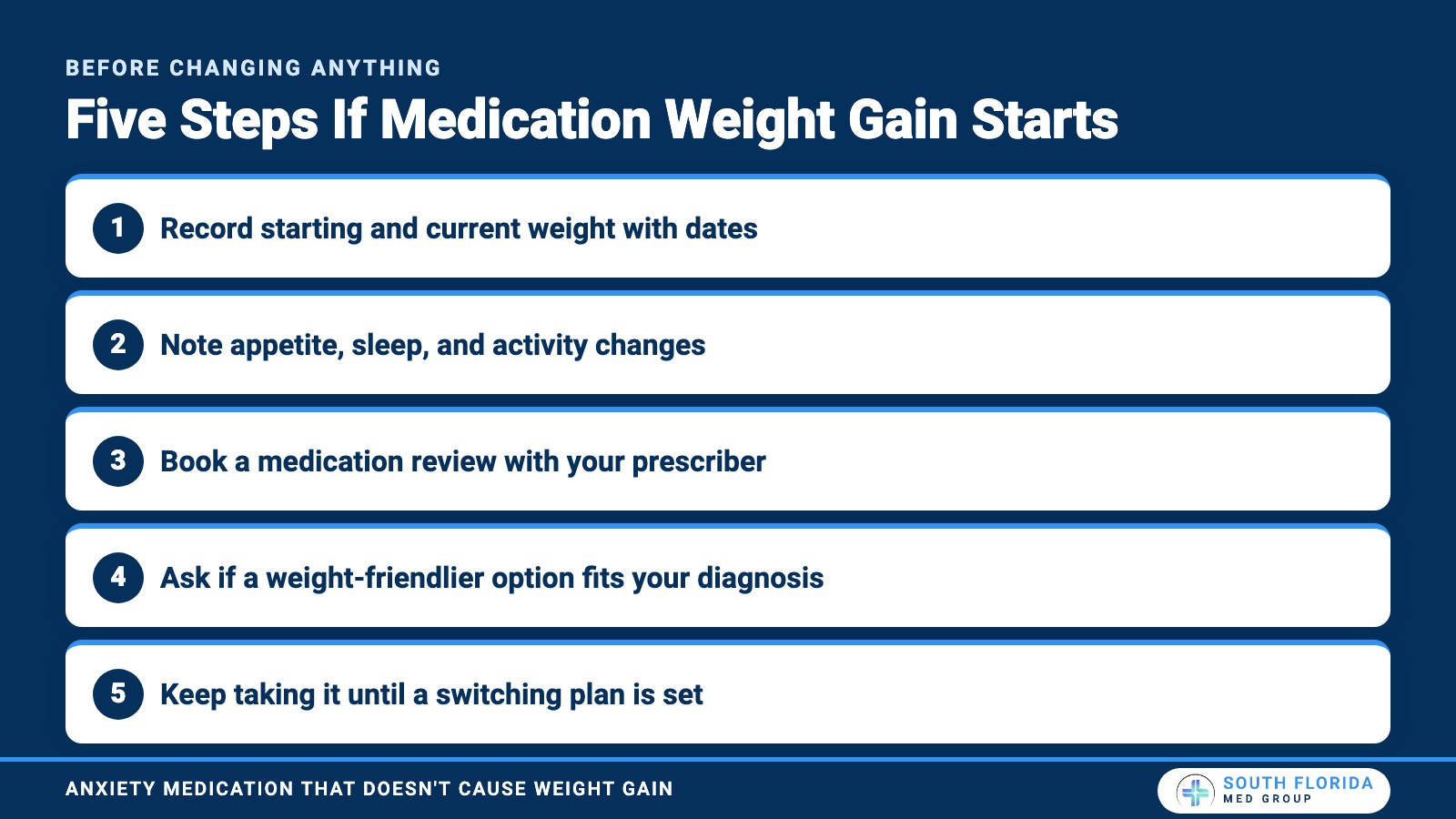
Call your prescriber before changing anything. The prescriber can review the dose, switch the drug, or add a plan for weight. Follow these steps in order:
- Record your starting weight and your current weight with dates.
- Note appetite changes, sleep changes, and activity changes since the start.
- Book a medication review visit with your prescriber.
- Ask whether a weight-friendlier option fits your diagnosis.
- Continue the current medication until the prescriber gives a switching plan.
Sudden stops can trigger withdrawal or relapse, so the plan matters. Read about stopping psychiatric medication to see why self-directed changes carry risk.
Anyone with thoughts of self-harm should call or text 988, the Suicide and Crisis Lifeline, or go to the nearest emergency room. The checklist below shows the five steps in order.
What Else Should You Know About Anxiety Medication and Weight?
Can Therapy Treat Anxiety Without Any Weight Effect?
Yes, therapy carries no medication side effects, so no drug-related weight change applies. Our talk-based treatment includes cognitive behavioral therapy for anxiety. Some patients combine therapy with medication under one plan.
Can You Take Anxiety Medication Through Telehealth?
Yes, a prescriber can review weight and symptoms by video at follow-up visits. Our remote prescriber visits let patients report a home scale reading. In-person visits remain available for examinations.
Can Anxiety and Depression Be Treated Together Without Weight Gain?
Yes, bupropion is one option when anxiety and depression occur together. Our co-occurring depression care plans account for this. A prescriber weighs anxiety symptoms carefully, since bupropion is not labeled for anxiety.
What Should You Bring to a Medication Review?
Bring your weight log, your medication list, and your symptom notes. Our medication decision quiz guide explains how providers weigh these details. The prescriber then compares each choice against your diagnosis.
Frequently Asked Questions
Does Venlafaxine Cause Weight Gain?
Venlafaxine averaged 0.17 kg more than sertraline at six months in the 2024 Annals study. That difference is small. Talk to your prescriber about your own weight history before and during treatment.
Is Buspirone Addictive?
The buspirone label describes the drug as not related to benzodiazepines, barbiturates, or other sedative anxiolytics. Benzodiazepines such as alprazolam carry label warnings about withdrawal after abrupt stops. Ask your prescriber about the right option.
Does Prozac Treat Panic Disorder?
Yes, the Prozac label includes acute treatment of panic disorder, with or without agoraphobia. It is also labeled for major depressive disorder, OCD, and bulimia nervosa. A prescriber decides whether it fits your diagnosis.
Does Duloxetine Cause Weight Gain?
Duloxetine averaged 0.34 kg more than sertraline at six months in the 2024 Annals study. Six-month adherence was 28% for duloxetine, the lowest of the eight drugs. Discuss your own weight history with your prescriber.
Does Lexapro Cause Weight Gain?
The Lexapro label reports no clinically important body weight change against placebo in its trials. The 2024 Annals study found escitalopram 0.41 kg above sertraline at six months. Both results are small averages, and individual results vary.
Does Paxil Cause Weight Gain?
The Paxil label lists weight gain as a frequent adverse reaction. The 2024 study found paroxetine 0.37 kg above sertraline at six months. Individual results vary.
How Does South Florida Med Group Help With Anxiety Medication and Weight?
Stephanie Cabrera, DNP, PMHNP-BC, FNP-BC, reviews your diagnosis, weight history, and medication options together. She leads care at South Florida Med Group. We offer in-person and telehealth visits, so follow-up weight checks fit your schedule. Weight records start at the first visit and continue at every follow-up. That routine gives the prescriber a clear trend to review.
We offer medication plan reviews and adjust the plan when weight changes. Our team compares each option against your diagnosis and weight record. An anxiety medication that doesn't cause weight gain is one choice we consider.
New patients can begin with new patient intake. Our Hialeah office is open Monday to Friday, 10 AM to 6 PM. Call (786) 860-8844 to schedule a visit.