How to ask your doctor for anxiety medication takes four moves: list symptoms, state the request, share history, and plan follow-up. The National Institute of Mental Health (NIMH) reports that 19.1% of U.S. adults had an anxiety disorder in the past year. A clear, honest list gives the provider the facts needed to decide whether medication, therapy, or both fit.
Key Takeaways
- Write down symptoms, triggers, and daily impact for at least a few days before the visit.
- Say the request directly, for example that you want to discuss medication for anxiety.
- Primary care providers, psychiatrists, and psychiatric nurse practitioners can all prescribe anxiety medication.
- Antidepressants usually take 4-8 weeks to work, so a follow-up visit belongs on the calendar.
- A provider decides on the medication after an evaluation, so ask about options rather than demanding one drug.
How to Ask Your Doctor for Anxiety Medication in Five Steps
Ask your doctor for anxiety medication by naming symptoms, requesting a medication discussion, and asking which options fit your history. A provider cannot prescribe from a request alone. An evaluation comes first, and the five steps below prepare you for it.
- Book a visit and tell the front desk the reason is anxiety, so enough time is set aside.
- Write down your symptoms, triggers, sleep, and how anxiety affects work and relationships.
- List every medication, vitamin, supplement, and caffeine or alcohol habit.
- Open the visit with one direct sentence about wanting to discuss medication.
- Close the visit by asking about side effects, timing, and the date of the follow-up.
A symptom assessment is the usual first appointment, because the evaluation shows which type of anxiety is present. The next section explains when the right moment to ask arrives.
When Is the Right Time to Ask Your Doctor About Anxiety Medication?
The right time to ask your doctor about anxiety medication is when worry interferes with sleep, work, school, or relationships. The U.S. Preventive Services Task Force (USPSTF) recommends screening for anxiety in adults 64 years or younger, regardless of risk factors. A screening question at any checkup can start the conversation.
The NIMH reports that 2.7% of U.S. adults had generalized anxiety disorder in the past year and 5.7% at some time in their lives. Past-year rates were 3.4% for females and 1.9% for males. Those numbers show that the problem is common and well studied.
Waiting for a crisis is not required. A person who has not yet decided on medication can still book a visit to talk about options, including therapy. Preparation makes that visit more useful, which leads to the written list.
What Should You Write Down Before Your Appointment?
Write down your symptoms, triggers, health history, current medications, and questions before your appointment. Notes keep the visit on track when nerves make it hard to remember details. A short list also gives the provider facts instead of general statements.
- Symptoms: what happens, how often, how long, and what makes it better or worse.
- Daily impact: missed work, avoided places, poor sleep, or strained relationships.
- Stressors: recent life changes and any past trauma you are comfortable sharing.
- Family history: anxiety, depression, bipolar disorder, or substance use in relatives.
- Health history: physical conditions, pregnancy plans, and past medication reactions.
- Current substances: prescriptions, supplements, caffeine, nicotine, and alcohol.
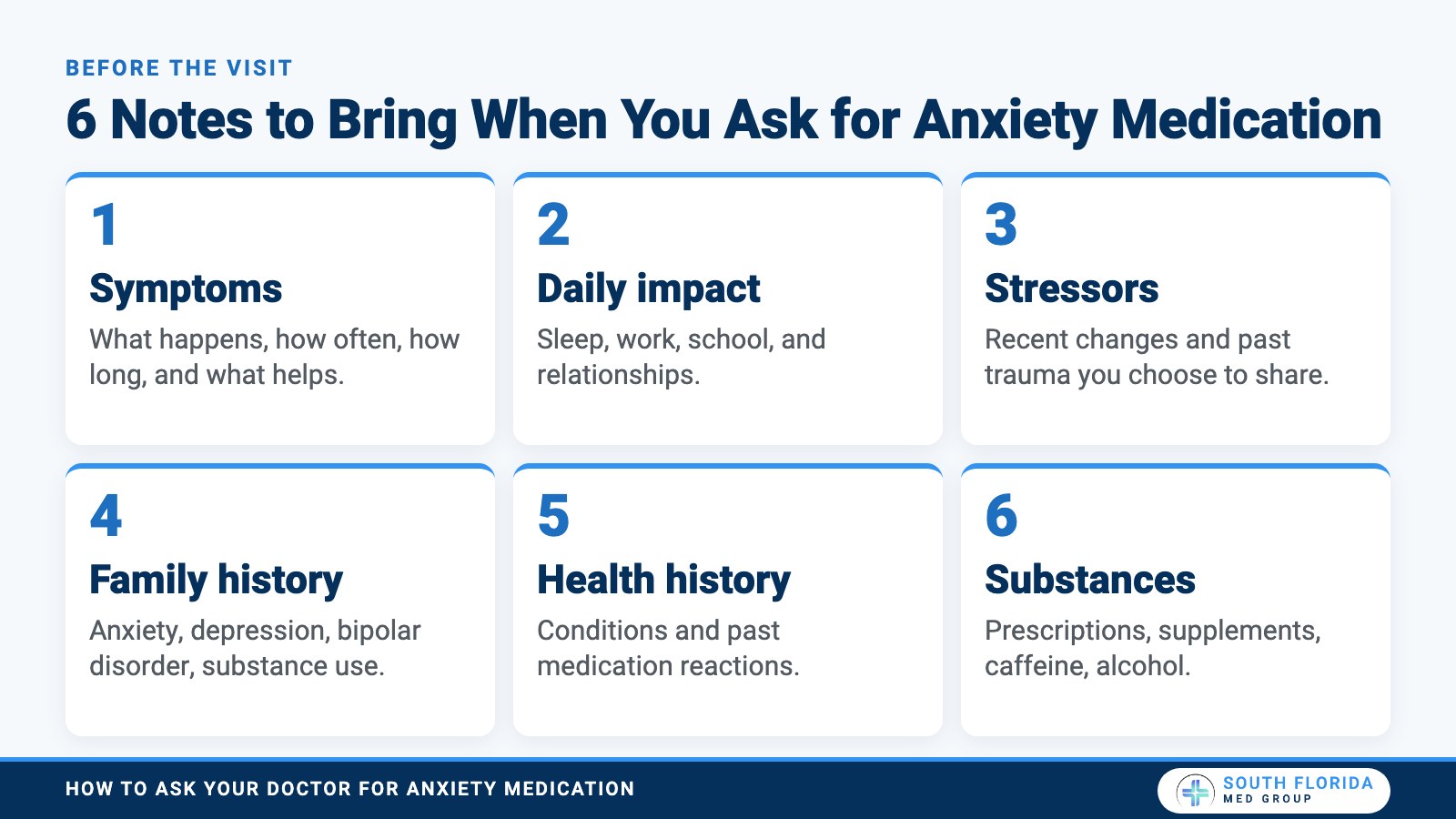
The checklist graphic above shows the six items to bring. Our evaluation preparation tips post covers the same ground in more detail. A scored questionnaire can add numbers to your notes.
What Is the GAD-7 and Should You Bring It?
The GAD-7 is a seven-question self-report scale that screens for generalized anxiety disorder (GAD) and rates its severity. A 2006 study in Archives of Internal Medicine tested it on 2,740 adults in 15 primary care clinics. Its cut point optimized sensitivity at 89% and specificity at 82%.
Sensitivity means the share of true cases the scale catches. Specificity means the share of non-cases it correctly clears. The authors concluded that the GAD-7 is a valid tool for screening and for assessing severity.
A GAD-7 score does not diagnose anxiety by itself. Many clinics hand it out at the visit, and bringing a completed copy saves time. Your scores sit beside your written notes, and both prepare you to speak up.
How to Talk to Your Doctor About Anxiety Medication
How to talk to your doctor about anxiety medication starts with symptoms first, then a request to discuss medication as one option. Specific words reduce awkwardness. Short, factual sentences work well, and the four phrasings below show the pattern.
- Describe the pattern with dates, such as three months of daily tension and four hours of sleep.
- Name the impact, such as missed work, and say you want to discuss medication.
- Mention what you already tried, such as breathing exercises, and ask to review options.
- Ask which side effects to expect and when the two of you will know it works.
Honesty about alcohol, cannabis, caffeine, and other prescriptions matters for safety. These substances change how medications act and how anxiety feels. After the opening statement, the provider will ask follow-up questions, and the next section covers naming a specific drug.
Can You Ask Your Doctor for a Specific Anxiety Medication?
Yes, you can mention a specific anxiety medication, but the provider chooses it after reviewing your diagnosis, history, and other prescriptions. Naming a drug you have read about opens a useful discussion. Asking about options works better than demanding one drug, so frame the request as a discussion.
The NIMH calls selective serotonin reuptake inhibitors (SSRIs) the usual starting point for panic and social anxiety. Serotonin-norepinephrine reuptake inhibitors (SNRIs) share that role because both cause fewer side effects. The table below summarizes common classes with FDA label facts. Label ranges are typical starting points, not recommendations for any person.
| Class | Example | Official note |
|---|---|---|
| SSRI | escitalopram (Lexapro) | FDA label for adult GAD lists an initial dose of 10 mg once daily. |
| SNRI | duloxetine (Cymbalta) | FDA label for GAD lists a usual start of 60 mg once daily, with a 30 mg option for 1 week. |
| Azapirone | buspirone | FDA label lists an initial dose of 15 mg daily. NIMH says it needs 3-4 weeks of daily use. |
| Benzodiazepine | alprazolam (Xanax) | FDA label lists 0.25 mg to 0.5 mg three times daily and carries a boxed warning. |
| Beta-blocker | propranolol | NIMH says it is prescribed off-label for short-term anxiety symptoms. |
The table shows that each class has a different timeline and risk profile. Benzodiazepines carry a boxed warning: the Xanax label includes a boxed warning for use with opioids, abuse, misuse, addiction, dependence, and withdrawal. A provider weighs those risks before prescribing, so expect questions about substance use. Medication choice also depends on who is prescribing.
What Kind of Doctor Prescribes Anxiety Medication?
A primary care provider, a psychiatrist, or a psychiatric nurse practitioner can prescribe anxiety medication. Each role differs in training and focus. A psychologist provides psychotherapy and refers you to a prescriber when medication is needed.
| Provider | Prescribes? | Typical role |
|---|---|---|
| Primary care provider | Yes | Rules out medical causes and starts treatment for straightforward anxiety. |
| Psychiatrist | Yes | Diagnoses and treats mental health conditions, including complex cases. |
| Psychiatric nurse practitioner | Yes | Diagnoses, prescribes, and manages medication for mental health conditions. |
| Psychologist | Refers | Provides psychotherapy and testing, then coordinates with a prescriber. |
The table above compares the four roles by prescribing ability. A psychiatric appointment suits people whose anxiety overlaps with depression, bipolar disorder, or trauma. Many people begin with a family provider, which raises the next question.
Can Your Primary Doctor Prescribe Anxiety Medication?
Yes, your primary doctor can prescribe anxiety medication, including SSRIs and buspirone, after an evaluation. A primary care provider also checks for physical causes such as thyroid problems or medication side effects. Mild to moderate anxiety is a common reason to start there.
A referral to psychiatry makes sense for severe symptoms, failed medication trials, bipolar disorder, or thoughts of self-harm. A regular doctor visit can also coordinate care with a therapist. The answer is the same for a general or family doctor.
The question "can a regular doctor prescribe anxiety medication" has one more layer. Controlled drugs such as benzodiazepines face stricter rules, and some practices refer those requests. Visits now also happen online, so the next question is about telehealth.
Is There an Online Doctor for Anxiety Medication?
Yes, a licensed provider can evaluate you and prescribe anxiety medication during a video visit, when the provider finds it appropriate. An online doctor for anxiety medication still takes a history, asks about symptoms, and sets follow-up. Telehealth removes the commute but not the evaluation.
An online psychiatric visit works well for follow-ups and medication checks. Some conditions and drugs still call for an in-person visit. Whatever the format, the appointment follows a predictable pattern.
What Happens at the Appointment After You Ask?
At the appointment, the provider asks about symptoms, history, and goals, then reviews medication and therapy options with you. The first visit includes questions about sleep, mood, substance use, and safety. The provider may also order blood tests to rule out medical causes.
A diagnostic visit ends with a plan: a medication, therapy, or both, plus a follow-up date. Ask the provider to repeat the plan in plain words. The timeline graphic below shows how the weeks after the visit unfold.
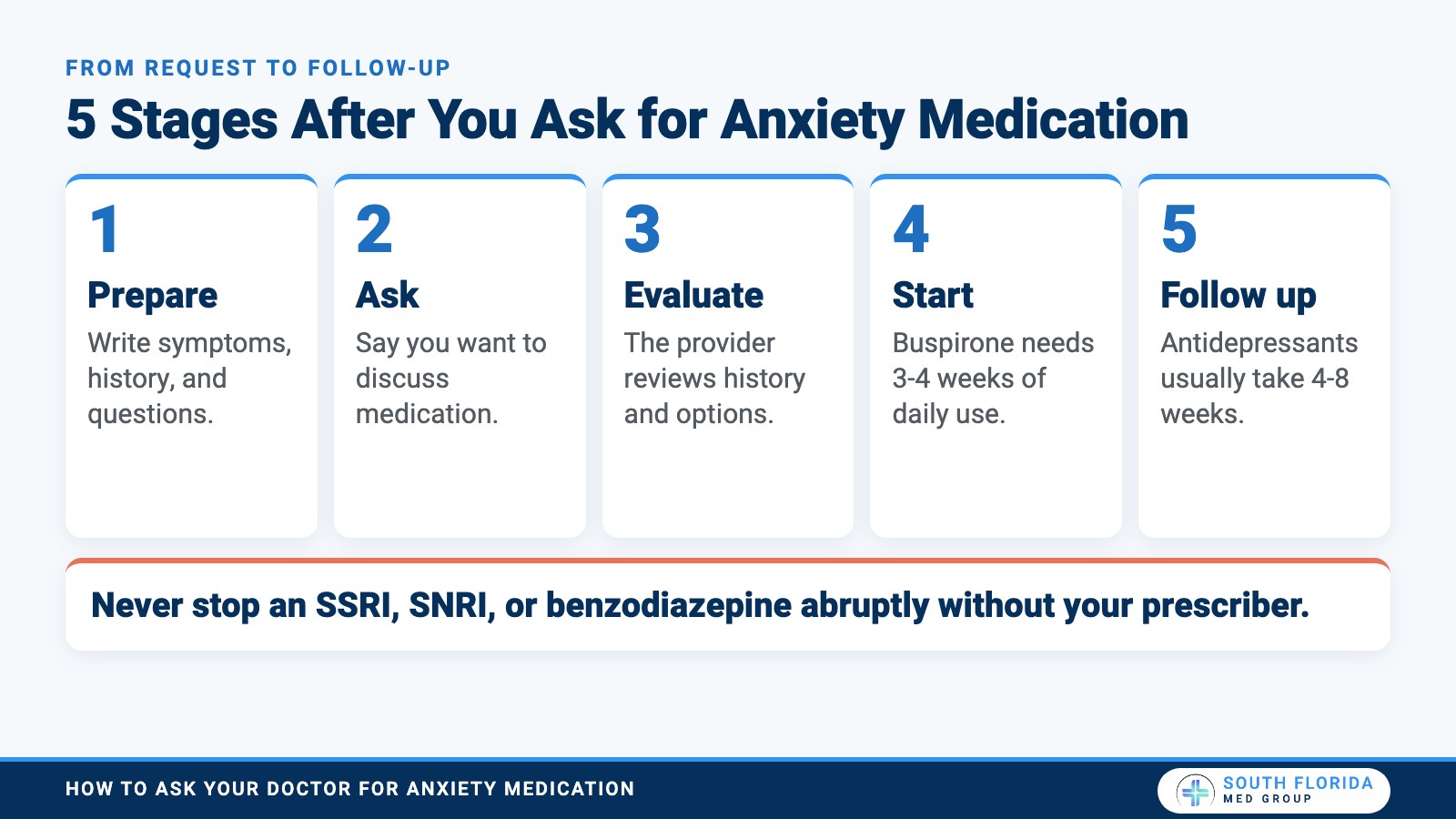
The graphic above lays out five stages from preparing the list to the follow-up. Weeks pass between the visit and the first benefit, which is the next topic.
How Long Does Anxiety Medication Take to Work?
Antidepressants used for anxiety usually take 4-8 weeks to work, according to the NIMH. Buspirone must be taken every day for 3-4 weeks to reach its full effect. Neither works as an as-needed pill.
The NIMH adds that sleep, appetite, and energy often improve before mood lifts. Giving a medication time before judging it is important. Never stop an SSRI, SNRI, or benzodiazepine abruptly without your prescriber, because stopping suddenly can cause withdrawal reactions.
The NIMH notes that people under 25 may have more suicidal thoughts in the first weeks of an antidepressant. The Lexapro label carries a boxed warning on this point. Call your prescriber right away about mood changes, or call 911 or go to the nearest emergency room in an emergency. You can also call or text 988, the Suicide & Crisis Lifeline.
How to Ask Your Doctor to Increase Your Anxiety Medication?
To ask your doctor to increase your anxiety medication, describe what has improved and what has not, then request a review. Give dates, symptom changes, and side effects. Never raise a dose on your own, because only your prescriber can adjust it safely.
- Say how long you have taken the current dose.
- Describe which symptoms remain and how they affect daily life.
- Report side effects, missed doses, and any new substances.
- Ask whether a dose change, a different drug, or added therapy fits.
Regular prescription follow-ups keep these reviews on schedule. Each review compares symptoms, side effects, and daily function against the last visit. The prescriber then sees a trend.
Tracking matters between visits, and a log of symptoms and side effects helps the review. The dose adjustment signs article lists what to record. A different request, for attention medication, follows its own path.
How to Ask Your Doctor for ADHD Medication?
To ask your doctor for ADHD medication, describe attention, focus, and organization problems that began in childhood and affect adult life. ADHD medication requires a diagnosis, so expect a full evaluation rather than a quick prescription. Providers also screen for anxiety, which can look similar.
Stimulant medications are controlled substances, and the FDA labels carry warnings on abuse and blood pressure. Bring school records, past evaluations, and examples from work.
An ADHD evaluation separates ADHD from anxiety, or finds both together. A provider may decline a request, and the next section covers that situation.
What If Your Doctor Says No or Brushes You Off?
When a doctor says no or brushes you off, ask what would change the decision and why. A provider may decline because the symptoms need more evaluation or because a drug carries risks. Asking for an explanation is reasonable, and the way to ask your doctor for anxiety medication again is to bring better notes.
A second opinion is also reasonable. Ask for a referral to a psychiatric provider, or book a mental health assessment with a practice that focuses on mental health. Stay calm, and bring your notes again. Next, a few side questions round out the topic.
What Else Should You Know About Asking for Anxiety Medication?
Will Asking Make You Look Like You Want Pills?
No, asking about medication does not label you, because it is a standard treatment question. Framing it as "what are my options" shows you want an informed plan. Honest answers about substance use also build trust.
Should You Bring Someone to the Visit?
Yes, a trusted person can help recall details and take notes. Tell the provider you want them in the room. Many practices allow a support person for the entire visit.
Is Therapy an Option Instead of Medication?
Yes, psychotherapy treats anxiety on its own or with medication. The medication decision guide explains how providers weigh the two. Ask about both at the same visit.
Is Generalized Anxiety the Only Type That Gets Medication?
No, panic disorder, social anxiety, and other types also respond to medication. Each diagnosis has its own FDA-labeled drugs. Generalized anxiety care differs from panic care in drug choice and timeline.
Can Anxiety Be Mistaken for a Medical Problem?
Yes, thyroid disease, heart rhythm problems, and caffeine can mimic anxiety. A provider checks for these first. Call 911 or go to the nearest emergency room for chest pain, fainting, or shortness of breath.
Frequently Asked Questions
How Do You Get Over the Fear of Taking a New Medication?
Ask the prescriber what the medication does, what side effects occur, and how to stop it safely. Knowing the plan reduces fear. A small written list of questions helps at the visit.
Does Anxiety Medication Make It Worse Before It Gets Better?
Some people notice side effects such as nausea, jitteriness, or sleep changes in the first weeks. The NIMH says benefits can take 4-8 weeks. Report any worsening to the prescriber, and do not stop on your own.
What Do Anti-Anxiety Meds Feel Like?
Responses differ by drug class. SSRIs and buspirone build slowly, while benzodiazepines act within a short time and carry dependence risks. Describe your experience at each follow-up.
How Can You Get Relief From Anxiety Without Medication?
Psychotherapy, regular exercise, steady sleep, and less caffeine all reduce anxiety symptoms. Cognitive behavioral therapy (CBT) is a common choice. Talk to your provider about combining these with medication.
Is Anxiety Medication Addictive?
The NIMH says long benzodiazepine use can cause tolerance and dependence, so providers prescribe short courses and taper slowly. SSRIs and SNRIs are not benzodiazepines, but they still should not be stopped abruptly. Ask about the risks of each option.
How Do You Get Anxiety Medication From a Doctor Without a Diagnosis?
A provider needs an evaluation before prescribing, so the visit itself produces the diagnosis. Describe your symptoms and ask what testing is needed. Medication follows only when the provider finds it appropriate.
How Does South Florida Med Group Help You Ask for Anxiety Medication?
South Florida Med Group offers evaluation and medication management for anxiety in Hialeah, with in-person and telehealth visits. Stephanie Cabrera, DNP, PMHNP-BC, FNP-BC, a psychiatric-mental health nurse practitioner and family nurse practitioner, leads care. We listen to your notes, review your history, and explain each option in plain words.
New patients can start with one visit, bring a written list, and leave with a plan. The same list helps later visits, and the steps for how to ask your doctor for anxiety medication repeat each time. You can reach us at (786) 860-8844, Monday to Friday, 10 AM to 6 PM. Book with South Florida Med Group when you are ready to talk.