


Low dose anxiety medication names include sertraline (Zoloft), paroxetine (Paxil), escitalopram (Lexapro), and buspirone. No drug class carries a low dose label. Prescribers start each medicine at the label starting dose and raise it over weeks. The Zoloft label starts panic disorder at 25 mg a day. The Paxil label starts generalized anxiety at 10 mg.
Key Takeaways
- Every anxiety medicine starts low and rises in steps, so "low dose" describes a stage of treatment, not a drug.
- FDA labels list starting doses from 10 mg for paroxetine in generalized anxiety to 25 mg for sertraline in panic disorder.
- SSRIs and SNRIs are the usual starting point for panic and social anxiety, according to the National Institute of Mental Health (NIMH).
- Hydroxyzine and buspirone are not benzodiazepines, but their label doses are not small.
- Benzodiazepines such as lorazepam and clonazepam carry boxed warnings for dependence and withdrawal.
- Only a prescriber sets a personal dose, and SSRIs, SNRIs, beta blockers, and benzodiazepines need a gradual taper.
What Are Low Dose Anxiety Medication Names?
Low dose anxiety medication names are the generic and brand names of anxiety drugs that begin at a small starting dose. The main names are sertraline (Zoloft), paroxetine (Paxil), fluoxetine (Prozac), escitalopram (Lexapro), venlafaxine (Effexor XR), duloxetine (Cymbalta), and buspirone. Hydroxyzine and several benzodiazepines complete the list of names of medication for anxiety.
Each name belongs to a drug class with its own mechanism. A prescriber matches the class to the diagnosis, other prescriptions, and health history during medication planning visits. The next question explains why no single drug owns the low dose label.
Is There a Low Dose Anxiety Medication?
No, there is no separate low dose anxiety medication, because every anxiety drug starts at a low dose and rises as needed. The low dose is a step in titration, the slow raising of a dose. The FDA label for each drug sets the starting amount and the steps that follow.
A phrase such as low dose anti anxiety medication therefore points to the first weeks of treatment. A person who stays on a starting dose may be at the label starting dose for months. A person who needs more moves up in steps. The lowest starting numbers appear in the table below.
What Is the Lowest Dose of Anxiety Medication?
The lowest dose of anxiety medication in the labels reviewed here is 0.25 mg twice daily for clonazepam (Klonopin) in panic disorder. Among daily antidepressants, the lowest label starting dose is 10 mg for paroxetine in generalized anxiety and fluoxetine in panic disorder. Milligrams cannot be compared across drugs, because each drug has a different strength.
The table below shows the typical label starting dose for each drug. These figures come from FDA labels on DailyMed and describe label ranges, not advice for any person.
| Generic (brand) | Class | Label starting dose | Label condition |
|---|---|---|---|
| Sertraline (Zoloft) | SSRI | 25 mg a day | Panic disorder, PTSD, social anxiety |
| Paroxetine (Paxil) | SSRI | 10 mg a day | Generalized anxiety, panic disorder |
| Paroxetine (Paxil) | SSRI | 20 mg a day | Social anxiety disorder |
| Fluoxetine (Prozac) | SSRI | 10 mg a day | Panic disorder |
| Escitalopram (Lexapro) | SSRI | 10 mg a day | Generalized anxiety |
| Venlafaxine (Effexor XR) | SNRI | 75 mg a day | Generalized anxiety |
| Duloxetine (Cymbalta) | SNRI | 60 mg a day, or 30 mg for 1 week | Generalized anxiety |
| Buspirone | Azapirone | 15 mg a day in divided doses | Anxiety disorders |
| Hydroxyzine hydrochloride | Antihistamine | 50 to 100 mg four times daily | Anxiety and tension |
| Clonazepam (Klonopin) | Benzodiazepine | 0.25 mg twice daily | Panic disorder |
| Alprazolam (Xanax) | Benzodiazepine | 0.25 to 0.5 mg three times daily | Anxiety, panic |
| Lorazepam (Ativan) | Benzodiazepine | 2 to 3 mg a day in divided doses | Anxiety |
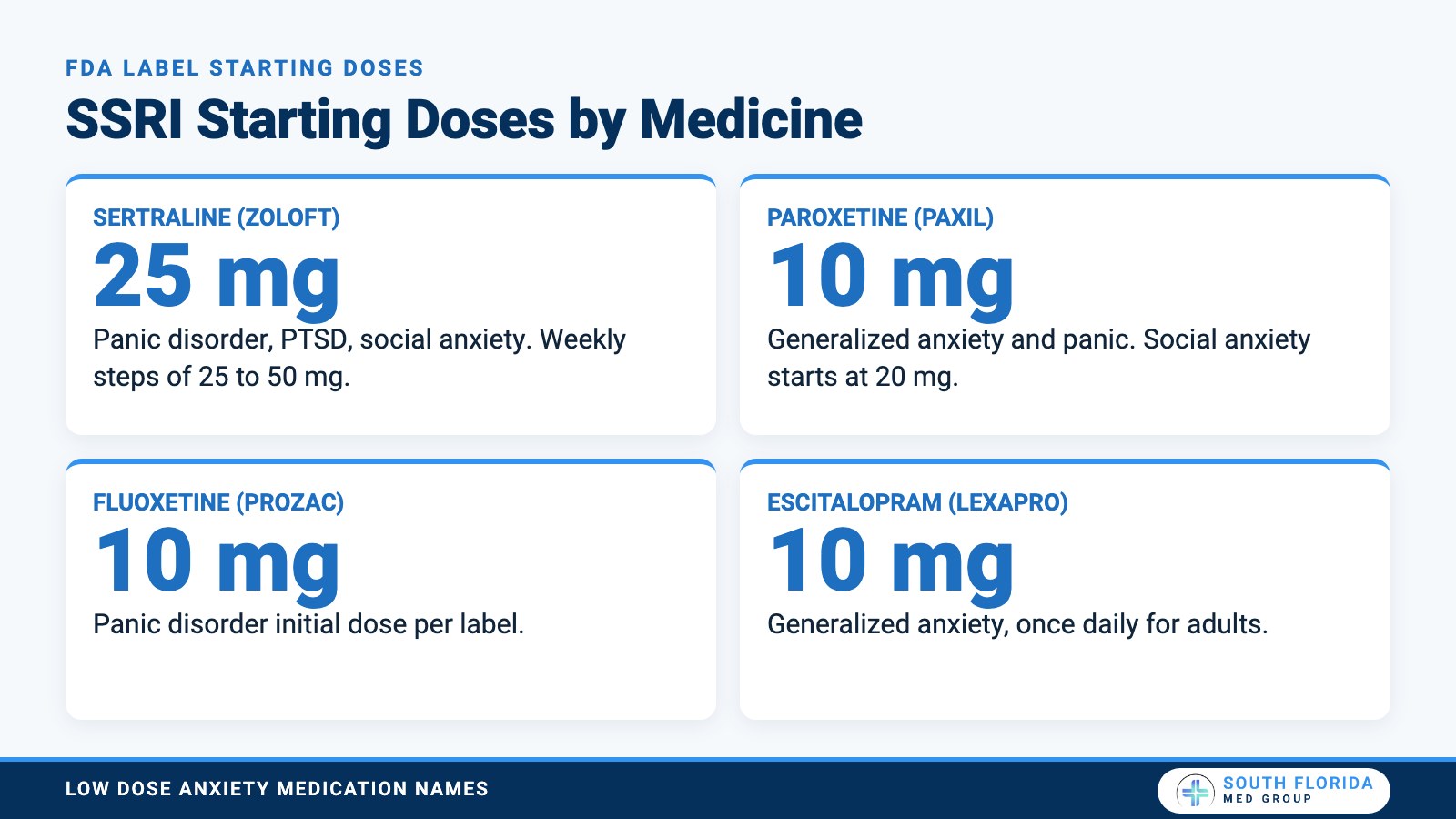
The table shows that a small number does not mean a mild drug. Hydroxyzine and lorazepam start at larger milligram amounts than paroxetine. The graphic below repeats the SSRI starting doses at a glance.
Why Do Prescribers Start Anxiety Medication at a Low Dose?
Prescribers start anxiety medication at a low dose to let the body adjust and to limit early side effects. The label starting dose is the first step, and the dose rises only when the response is not enough. NIMH reports that antidepressants usually take 4 to 8 weeks to work.
Early weeks need close follow-up. The FDA boxed warning on antidepressants such as Prozac describes suicidal thoughts and behaviors in children, adolescents, and young adults. A prescriber checks mood, sleep, and side effects at each visit. Regular medication adjustment signs guide those visits.
The steps below show how a typical label-based titration moves from the starting dose to a stable dose.
How Does a Prescriber Raise the Dose Step by Step?
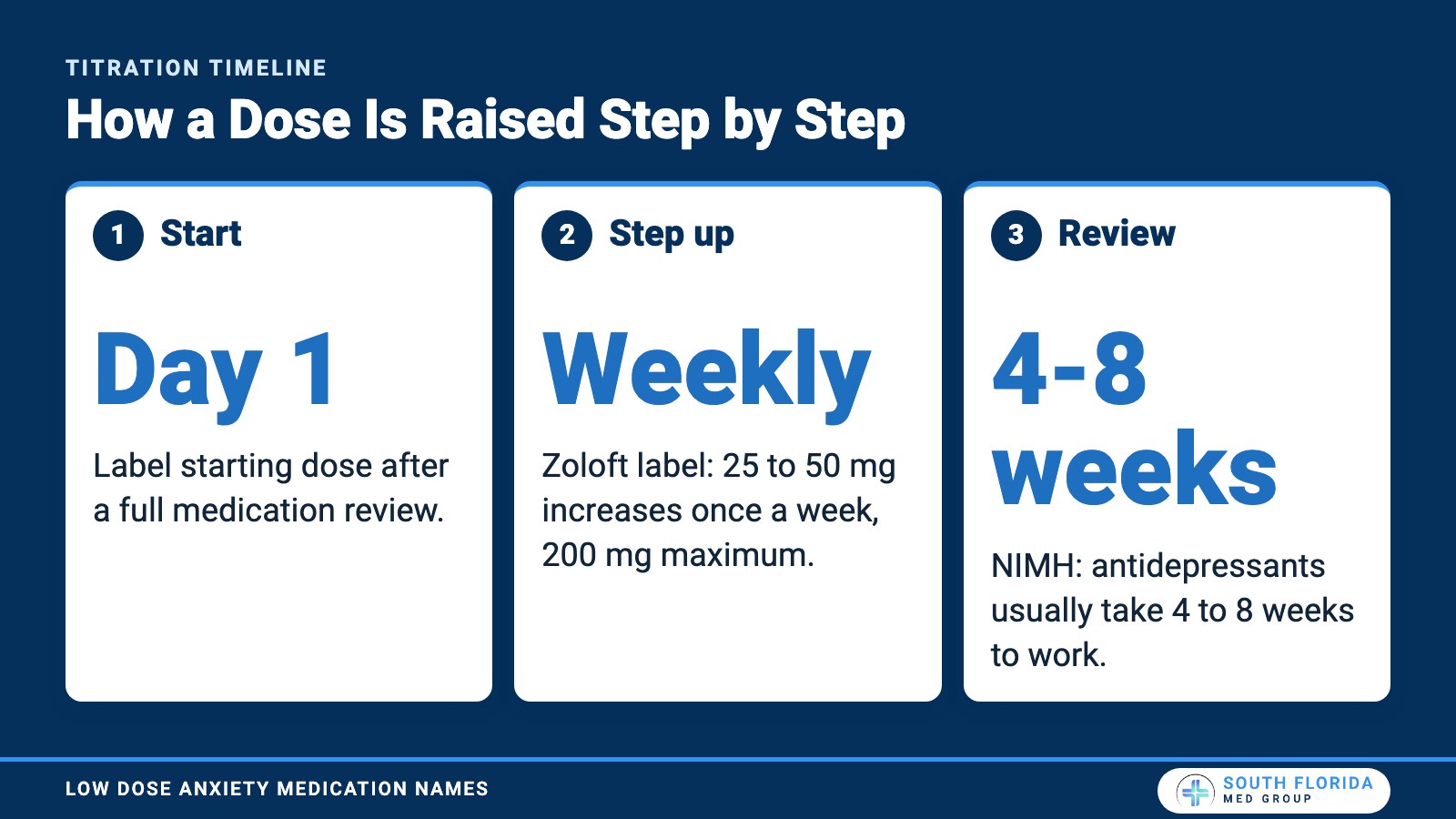
A prescriber raises the dose in small, timed steps. The Zoloft label allows increases of 25 to 50 mg once a week, to a 200 mg daily maximum. Other drugs use different steps. The Paxil label raises generalized anxiety from 10 mg to 20 mg after one week.
- The prescriber confirms the diagnosis and reviews every current medicine.
- The patient starts at the label starting dose.
- The prescriber raises the dose in timed steps only when response is limited.
- The team reviews benefit and side effects at weeks 4 to 8.
- The prescriber holds, changes, or tapers the drug, never the patient alone.
The timeline graphic below maps this sequence for an SSRI. Each step ends with a review, so the next question looks at the SSRI names in detail.
How Long Does Low Dose Anxiety Medication Take to Work?
Low dose anxiety medication takes weeks to work, and NIMH reports that antidepressants usually take 4 to 8 weeks. Buspirone needs daily use for 3 to 4 weeks to reach its full effect. A starting dose therefore needs time before anyone judges it.
Early weeks can bring side effects before any benefit. Our psychiatric prescribers keep the dose steady during this period unless a problem appears. Benzodiazepines and beta blockers differ, because NIMH describes them as short-term, as-needed options. The next sections name each SSRI and SNRI on the list.
Which SSRIs Are Low Dose Anxiety Medication Names?
The SSRIs on anxiety medication names lists are sertraline (Zoloft), paroxetine (Paxil), fluoxetine (Prozac), escitalopram (Lexapro), and citalopram (Celexa). SSRIs, or selective serotonin reuptake inhibitors, raise serotonin signaling in the brain. NIMH says providers start panic and social anxiety care with SSRIs or related antidepressants.
Label conditions differ by drug. Sertraline lists panic disorder, PTSD, and social anxiety. Escitalopram lists generalized anxiety, with a label starting dose of 10 mg a day. Paroxetine lists generalized anxiety, panic, and social anxiety. Our anxiety disorder treatment page describes how each condition is assessed.
SNRIs share the same first-line role, so the next group covers their names.
Which SNRIs Appear on Anti Anxiety Medication Names Lists?
The SNRIs on anti anxiety medication names lists are venlafaxine (Effexor XR) and duloxetine (Cymbalta). SNRIs, or serotonin and norepinephrine reuptake inhibitors, act on two brain chemicals instead of one. The Effexor XR label starts generalized anxiety at 75 mg a day.
The Cymbalta label gives a usual start of 60 mg once daily, with a 30 mg option for the first week. Both labels warn about blood pressure effects, so a prescriber checks blood pressure before and during treatment. A person with high blood pressure should discuss this with the prescriber.
Buspirone works in a different way from SNRIs, so it has its own section.
Is Buspirone a Low Dose Anxiety Medication?
Buspirone is a daily anxiety medicine, and the label recommends an initial dose of 15 mg a day in divided doses. Divided means 7.5 mg twice daily. NIMH states that buspirone must be taken every day for 3 to 4 weeks to reach its full effect.
Buspirone is not a benzodiazepine and does not calm a panic attack in the moment. The label lists weight gain and libido change as infrequent events. A prescriber may pair buspirone with an SSRI. Hydroxyzine takes the opposite approach, because a person takes it as needed.
Is Hydroxyzine a Low Dose Anxiety Medication?
Hydroxyzine is an antihistamine used for anxiety, and the label lists 50 to 100 mg four times daily for adults. That range is not small. The label also states that its usefulness beyond 4 months has not been assessed by systematic clinical studies.
Drowsiness is the main effect, and the label warns against driving until the response is known. Older adults need extra care. The label says elderly patients should be started on low doses and watched closely. Propranolol also targets physical symptoms, so it follows next.
Is Propranolol Used as a Low Dose Anxiety Medication?
Propranolol is used off-label for short-term anxiety, and NIMH states that beta blockers are not approved for that purpose. Beta blockers block adrenaline at receptors in the heart and blood vessels. That action slows a racing heart and steadies tremor.
The Inderal LA label lists hypertension, angina, and migraine prevention, not anxiety. The label lists bronchial asthma and a slow heart rate (sinus bradycardia) as contraindications. A person must never stop propranolol abruptly without a prescriber, because a sudden stop can worsen angina. The next section compares daily and as-needed options.
What Is the Difference Between Daily and As-Needed Anxiety Medication?
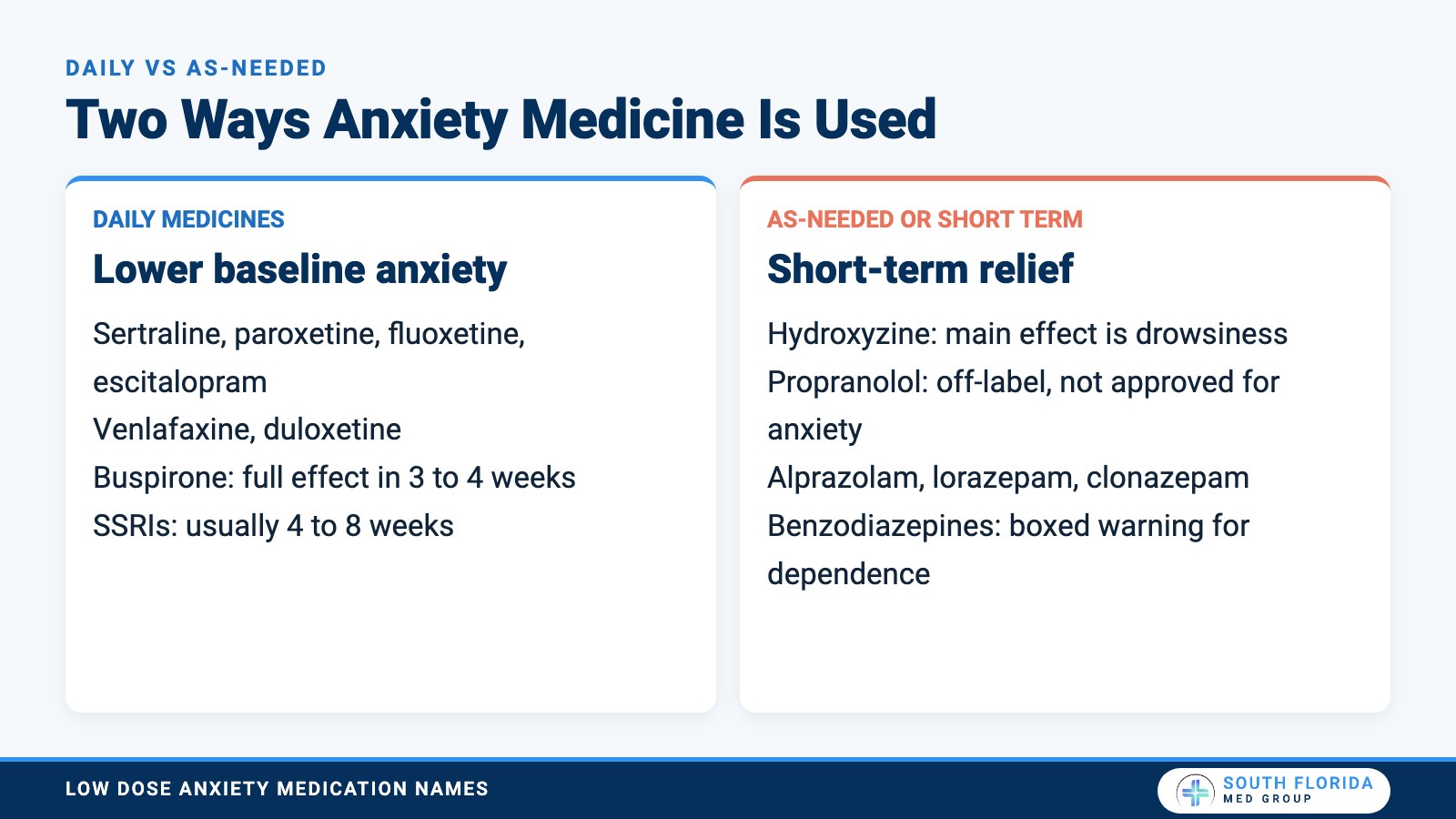
Daily anxiety medication is taken every day to lower baseline anxiety. As-needed medication is taken for short-term relief of severe symptoms. SSRIs, SNRIs, and buspirone belong to the daily group. Benzodiazepines, beta blockers, and hydroxyzine are used as needed or for short periods.
The table below lists each group by name, timing, and the main label point.
| Group | Names | Timing | Main label point |
|---|---|---|---|
| SSRIs | Sertraline, paroxetine, fluoxetine, escitalopram | Daily | Weeks to full effect; boxed warning for youth |
| SNRIs | Venlafaxine, duloxetine | Daily | Blood pressure monitoring |
| Azapirone | Buspirone | Daily, divided doses | Full effect in 3 to 4 weeks |
| Antihistamine | Hydroxyzine | As needed or divided doses | Drowsiness; use beyond 4 months not assessed |
| Beta blocker | Propranolol | Short term, off-label | Not approved for anxiety |
| Benzodiazepines | Alprazolam, lorazepam, clonazepam, diazepam | Short periods | Boxed warning for dependence |
The graphic below shows the same split at a glance. A short checklist of what to tell the prescriber comes after it.
What Should You Tell the Prescriber Before Starting Anxiety Medication?
Tell the prescriber about every medicine, health condition, and past reaction before starting anxiety medication. Liver, kidney, heart, and lung conditions can change the label starting dose or rule a drug out. The Zoloft label halves the starting dose in mild liver impairment. The Paxil label starts severe kidney or liver impairment at 10 mg.
- List every prescription, over-the-counter medicine, and supplement.
- Report asthma or a slow heart rate before any beta blocker.
- Report opioid use before any benzodiazepine, because the boxed warning covers opioid co-use.
- Report pregnancy plans, liver disease, or kidney disease.
- Report any past reaction to an anxiety or antidepressant medicine.
A complete list lets the prescriber pick a starting dose with fewer surprises. Name lists then become a short, personal shortlist. The benzodiazepine group has the strictest label warnings, so it comes next.
What Are the Benzodiazepine Names for Anxiety?
The benzodiazepine names for anxiety are alprazolam (Xanax), lorazepam (Ativan), clonazepam (Klonopin), and diazepam (Valium). Benzodiazepines are fast-acting and meant for short periods. NIMH says long use may cause tolerance or dependence, so prescribers taper them slowly.
The Ativan label lists 2 to 3 mg a day as the initial anxiety dose. For elderly or debilitated patients, the label lists 1 to 2 mg a day. The FDA boxed warning covers opioid co-use, abuse, misuse, addiction, dependence, and withdrawal. A person should never stop a benzodiazepine abruptly without a prescriber. The brand list in the next section groups every name by letter.
Which Anxiety Medication Names Start With Each Letter?
Anxiety medication names that start with the same letter are easy to confuse. The list below pairs each generic name with its brand name. The list is a name reference, not a ranking. The names also work as an anti anxiety medication brand names guide.
- A: alprazolam (Xanax).
- B: buspirone.
- C: citalopram (Celexa), clonazepam (Klonopin).
- D: diazepam (Valium), duloxetine (Cymbalta).
- E: escitalopram (Lexapro).
- F: fluoxetine (Prozac).
- H: hydroxyzine.
- L: lorazepam (Ativan).
- P: paroxetine (Paxil), propranolol (Inderal).
- S: sertraline (Zoloft).
- V: venlafaxine (Effexor XR).
Names alone do not show which drug fits a person. The side questions below cover the details readers ask most.
What Else Should You Know About Low Dose Anxiety Medicine?
Does Low Dose Anxiety Medication With Minimal Side Effects Exist?
No, a lower dose does not remove side effects, but a slow start lets the body adjust. Early effects such as nausea, headache, or drowsiness can appear at any starting dose. The anxiety medicine comparison covers each class in more detail.
Can Older Adults Take Low Dose Anxiety Medication?
Older adults can take anxiety medication when a prescriber lowers the start. The Paxil label starts geriatric patients at 10 mg a day with a 40 mg maximum. The Ativan label advises 1 to 2 mg a day for elderly or debilitated patients.
Is Low Dose Anxiety Medication for Kids and Teens Different?
Yes, young patients need pediatric labeling and closer monitoring. The Lexapro label covers generalized anxiety in children aged 7 and older. The antidepressant boxed warning adds extra monitoring for suicidal thoughts in children, adolescents, and young adults.
Can You Stop Low Dose Anxiety Medication Quickly?
No, never stop an anxiety medication abruptly without a prescriber. The Paxil label says to reduce the dosage gradually when discontinuing. This safe medication tapering guide explains why a plan matters.
Does Therapy Work Alongside Low Dose Medication?
Yes, a prescriber can combine medication with talk therapy. Medication addresses brain chemistry, while therapy builds coping skills. Structured therapy for anxiety runs beside any prescription.
Can a Telehealth Visit Review Anxiety Medication?
Yes, a telehealth visit can cover follow-ups, side effect checks, and dose reviews. The prescriber decides what fits each patient. Our online prescriber visits add flexibility between in-person appointments.
When Does Anxiety Need Emergency Help?
Chest pain, fainting, or shortness of breath needs a call to 911 or a trip to the nearest emergency room. Thoughts of self-harm need the 988 Suicide and Crisis Lifeline or 911. Do not wait for a scheduled medication visit.
Frequently Asked Questions
What Is a Good Low Dose Anxiety Medication?
No single drug is good for everyone. A prescriber chooses by diagnosis, health history, and other prescriptions. NIMH says SSRIs and SNRIs are the usual starting point for panic and social anxiety.
What Anxiety Medication Is Prescribed First?
NIMH states that providers typically start panic disorder and social anxiety care with SSRIs or other antidepressants. Buspirone is used for longer-term anxiety. Benzodiazepines and beta blockers are used as needed for short-term symptoms.
Is Anxiety Medication Common?
NIMH reports that 19.1% of U.S. adults had an anxiety disorder in the past year. Not every person with an anxiety disorder takes medication. A prescriber decides after an evaluation.
Is There a Low Dose Anxiety Medication for Sleep?
Hydroxyzine causes drowsiness, according to its label, but it is labeled for anxiety, not sleep. A prescriber decides whether any medicine fits a sleep problem. Anxiety and sleep need a joint plan.
Is Low Dose Anxiety Medication for Dogs the Same as Human Medicine?
No, human anxiety medicine should never be given to a pet. A veterinarian chooses animal medicine and dose. This post covers FDA labels for human adults only.
Can You Take Low Dose Anxiety Medication While Pregnant?
A prescriber weighs the label risks against the need for treatment. Do not stop a medicine on your own during pregnancy. Call the prescriber before any change.
How Does South Florida Med Group Help With Anxiety Medication?
We help patients review anxiety medication names, label doses, and side effects in one visit. At South Florida Med Group, each visit covers the diagnosis and current prescriptions. The visit also covers the label starting dose for any drug under review. Visits run in person at our Hialeah office or by telehealth.
Stephanie Cabrera, DNP, PMHNP-BC, FNP-BC, is our lead provider. She is a psychiatric-mental health nurse practitioner and a family nurse practitioner. She reviews each plan with the patient and answers questions about dose steps and side effects.
Patients who want a first look can take the medication need quiz before a visit. The quiz does not replace an evaluation by a prescriber. Results give the patient a starting point for the conversation. Bring the results, a list of current medicines, and any questions about label doses to the first appointment.
Each step of dose titration support stays supervised from the first dose to the review. Call (786) 860-8844 to book an in-person or telehealth visit.