


Panic attack coping skills are learned techniques, such as paced breathing, grounding, and thought testing, that lower fear and shorten attacks. The National Institute of Mental Health (NIMH) reports that 4.7% of U.S. adults develop panic disorder at some point in life. Cognitive behavioral therapy (CBT) teaches these skills, and in one JAMA trial 48.7% of CBT patients responded, compared with 21.7% on placebo.
Key Takeaways
- Panic attack coping skills interrupt the loop of body sensations, alarming thoughts, and more adrenaline.
- Most panic attacks last 5 to 20 minutes, according to the National Health Service (NHS), and they are not dangerous.
- CBT is the core therapy, built from breathing training, cognitive restructuring, and interoceptive exposure.
- A 312-patient JAMA trial found CBT responders at 48.7%, against 21.7% for placebo.
- Caffeine, alcohol, sugary drinks, and avoidance make attacks worse, so habits matter as much as in-the-moment tricks.
- Chest pain, fainting, or trouble breathing needs a call to 911 or a trip to the nearest emergency room.
What Are Panic Attack Coping Skills and How Do They Work?
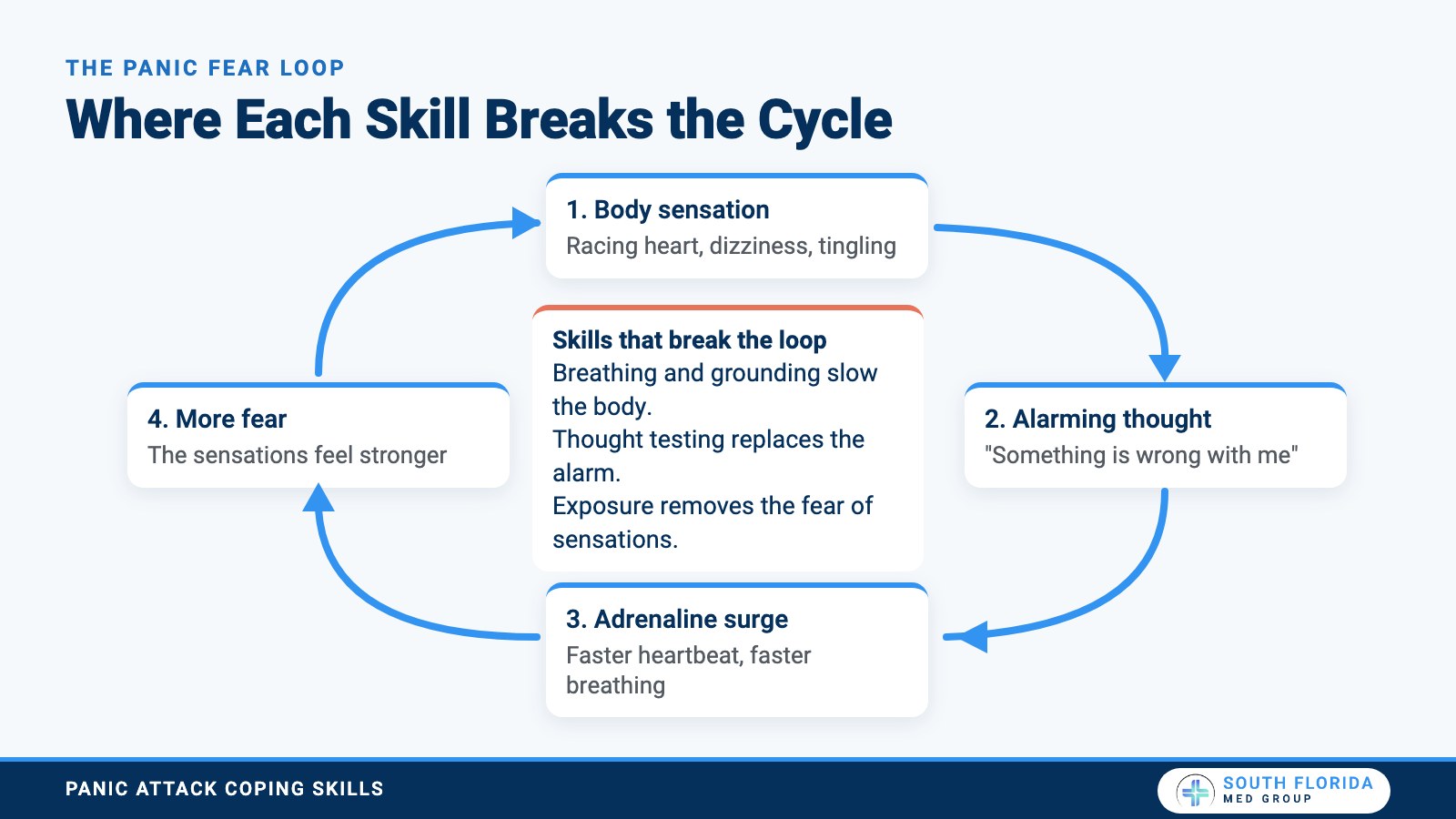
Panic attack coping skills are learned habits that calm the body and change the thoughts that fuel an attack. They work by breaking the fear loop. In that loop, a racing heart triggers a frightening thought, and the thought releases more adrenaline. Adrenaline is the stress hormone that speeds the heart and quickens breathing. The fight-or-flight response is the body's automatic alarm for danger.
The NHS states that panic attacks are frightening but not dangerous, and an attack will not cause physical harm. Skills practiced between attacks become automatic under stress. A therapist teaches them step by step in panic disorder therapy, using exercises that build on each other. The skills fall into five groups, shown in the graphic below.
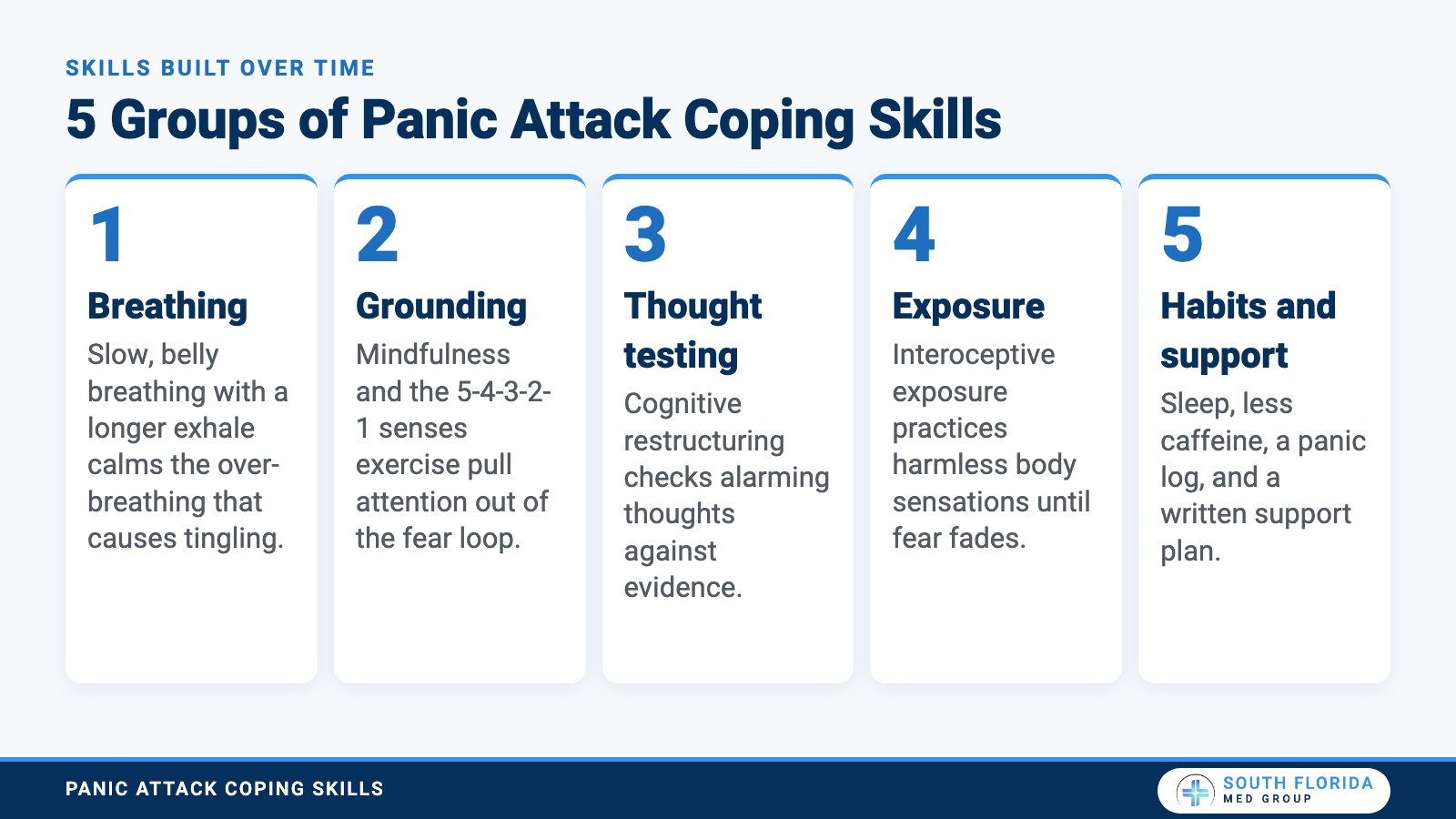
The five groups are breathing, grounding and mindfulness, cognitive restructuring, interoceptive exposure, and habits with support. The next section sorts the terms people use for them.
Are Panic Attack Coping Strategies, Mechanisms, and Techniques the Same Thing?
Yes, panic attack coping strategies, panic attack coping mechanisms, and panic attack coping techniques share one goal. That goal is handling fear sensations safely, but each term covers a different scope. A technique is one action, a strategy is a plan, and a skill is an ability built through repetition. A mechanism is any automatic response, and it can help or harm. The table below compares the four terms.
| Term | Meaning | Example | When it is used |
|---|---|---|---|
| Coping skill | An ability built through practice | Paced breathing | Daily, then during attacks |
| Coping strategy | A plan that combines several skills | A written support plan | Before and during attacks |
| Coping technique | One specific action | The 5-4-3-2-1 grounding exercise | During an attack |
| Coping mechanism | An automatic response, helpful or harmful | Slowing the exhale, or avoiding a store | Whenever panic rises |
The table shows that harmful mechanisms exist too. NIMH lists fear and avoidance of places where attacks occurred as a symptom of panic disorder. Avoidance feels like relief, yet it teaches the brain that the place is dangerous. Learning body changes explains why helpful panic attack coping methods work where avoidance fails.
How to Cope During a Panic Attack?
Cope during a panic attack by naming it, slowing the exhale, grounding, relaxing muscles, and staying put. Most attacks peak and fade within 5 to 20 minutes, based on NHS information, and some last up to an hour. Knowing how to cope during a panic attack means running a short script instead of fighting the sensations. The five steps below form that script.
- Name the attack by saying that it is panic and that it will pass.
- Breathe in for 4 seconds and out for 6 seconds, since a longer exhale slows the heart.
- Ground your senses by naming 5 objects you see, 4 you touch, 3 you hear, 2 you smell, and 1 you taste.
- Tense your fists, shoulders, and legs for 5 seconds, then release them.
- Stay where you are until the peak passes, and rate your fear from 0 to 10.
These steps are a coping routine, not full treatment for panic disorder. A separate guide on how to fast calming steps covers speed-focused tricks. This post focuses on skills built over weeks, starting with breathing.
How Does Breathing Training Help With Panic Attacks?
Breathing training helps with panic attacks by slowing the breath, which stops the over-breathing that causes dizziness and tingling. Slow, diaphragmatic breathing lowers the urge to gasp and gives the nervous system a signal of safety. Hyperventilation is breathing too fast, and it lowers carbon dioxide in the blood. Lower carbon dioxide produces lightheadedness, tingling fingers, and chest tightness.
The NHS advises people to breathe slowly and deeply and to practice breathing exercises as part of preventing attacks. NIMH notes that exposure therapy may be paired with relaxation exercises and breathing training. Practice a few minutes daily while calm, with one hand on the belly. A trained skill is easier to find during panic. Breathing handles the body, and the next skill handles the mind.
What Is Cognitive Restructuring for Panic Attacks?
Cognitive restructuring is a CBT skill that tests alarming thoughts against evidence and replaces them with accurate ones. The skill targets catastrophic thinking, which means expecting the worst outcome from a normal body sensation. A thought like "I am dying" gets tested against the facts. NIMH explains that CBT teaches new ways of thinking, behaving, and reacting to feelings during or before a panic attack.
The process has three moves: write the thought, list the evidence for and against it, and write a balanced replacement. The replacements become panic attack coping statements that you rehearse daily. Examples include the lines below.
- "This is adrenaline, and it will pass".
- "My heart is fast, but it is working normally".
- "I have felt this before, and I came through it".
- "I do not need to escape to be safe".
- "The peak is short, and I can wait it out".
Statements work well when they are believable rather than forced. The thought loop is only half the pattern, because the body sensations feed it. The graphic below shows where each skill breaks the loop.
What Is Interoceptive Exposure and Why Does It Reduce Panic?
Interoceptive exposure is a CBT technique that practices harmless body sensations linked to panic until the fear of them fades. The sensations lose their power once the brain learns they are uncomfortable but safe. NIMH defines the technique as exposure to bodily sensations associated with panic attacks and panic disorder symptoms. A therapist usually guides the first sessions.
Exercises mimic attack sensations in a controlled way. Spinning in a chair creates dizziness, and jogging in place raises the heartbeat. Each exercise is repeated while fear is rated from 0 to 10, and the rating drops over repeats. People with heart or lung conditions need a medical check from primary care before starting. Structured CBT sessions add a second layer, situational exposure, which means returning step by step to places that were avoided.
How Does Mindfulness Help You Cope With Panic Attacks?
Mindfulness helps you cope with panic attacks by training attention to notice sensations and thoughts without reacting to them. Observing a sensation without judging it removes the second wave of fear that builds on the first. The person labels the feeling as a tight chest instead of concluding that something is wrong.
Grounding is the quickest form of mindfulness, because it pulls attention to the five senses. A body scan moves attention from head to toes and notes tension without trying to change it. Mindfulness works alongside the CBT skills above and does not replace them. Writing down each attack builds on the same observing habit.
Do Journaling and a Panic Attack Coping Skills Worksheet Help?
Yes, journaling and a worksheet help because they turn each attack into data about triggers, thoughts, and skills. A written log shows patterns that memory misses, such as attacks after poor sleep or heavy caffeine. Worksheets and printable handouts from a therapist use the same columns, shown in the table below.
| Column | What to record | Why it helps |
|---|---|---|
| Trigger | The place, event, or sensation before the attack | Shows patterns for exposure practice |
| Body sensations | Racing heart, dizziness, or tingling | Lists sensations to rehearse in exposure |
| Thought | The scariest thought, in your own words | Gives material for cognitive restructuring |
| Fear rating | A score from 0 to 10, before and after | Shows progress in numbers |
| Skill used | Breathing, grounding, or a coping statement | Shows which skill works for you |
The table lists five columns that take about two minutes to fill after an attack. A therapist reviews the log to choose the next exposure exercise. The same log feeds a support plan, covered next.
How Do You Build a Panic Attack Support Plan?
Build a panic attack support plan by writing skills, warning signs, contacts, and emergency steps on one page. A written plan removes decisions during a moment when thinking feels hard. Keep a copy on your phone and one on paper. A plan should include these five parts.
- Your top three coping skills, in the order you will use them.
- Your early warning signs, such as a tight throat or racing thoughts.
- One trusted contact and a short message, such as asking them to stay on the phone.
- A safe place to sit, at home, at work, or in the car.
- The rule for emergencies: chest pain, fainting, or trouble breathing means 911.
A plan can also name online therapy visits as a backup when travel is hard. Habits shape how often the plan gets used, so the next section covers triggers.
What Makes Panic Attacks Worse?
Caffeine, alcohol, nicotine, sugary food and drinks, poor sleep, and avoidance make panic attacks worse. The NHS says sugar, caffeine, alcohol, and smoking can all make attacks worse. The NHS also recommends regular exercise and relaxing activities such as yoga. NIMH adds that enough sleep, exercise, a healthy diet, and trusted support help, although lifestyle alone cannot replace treatment.
Caffeine is a stimulant that mimics panic sensations, such as a racing heart and jitteriness. Alcohol calms the body briefly and then raises anxiety as it wears off. Avoidance may be the strongest maintainer because it blocks learning. Coping skills for panic attack prevention work well when habits support them. Therapy then turns those habits into a full treatment plan.
What Role Does Therapy Play in Panic Attack Coping Skills?
Therapy plays the central role in building coping skills because CBT teaches, rehearses, and tests each skill with a trained guide. NIMH states that CBT is commonly used to treat panic disorder. Attacks can become less frequent once a person learns to react differently to physical sensations, NIMH adds.
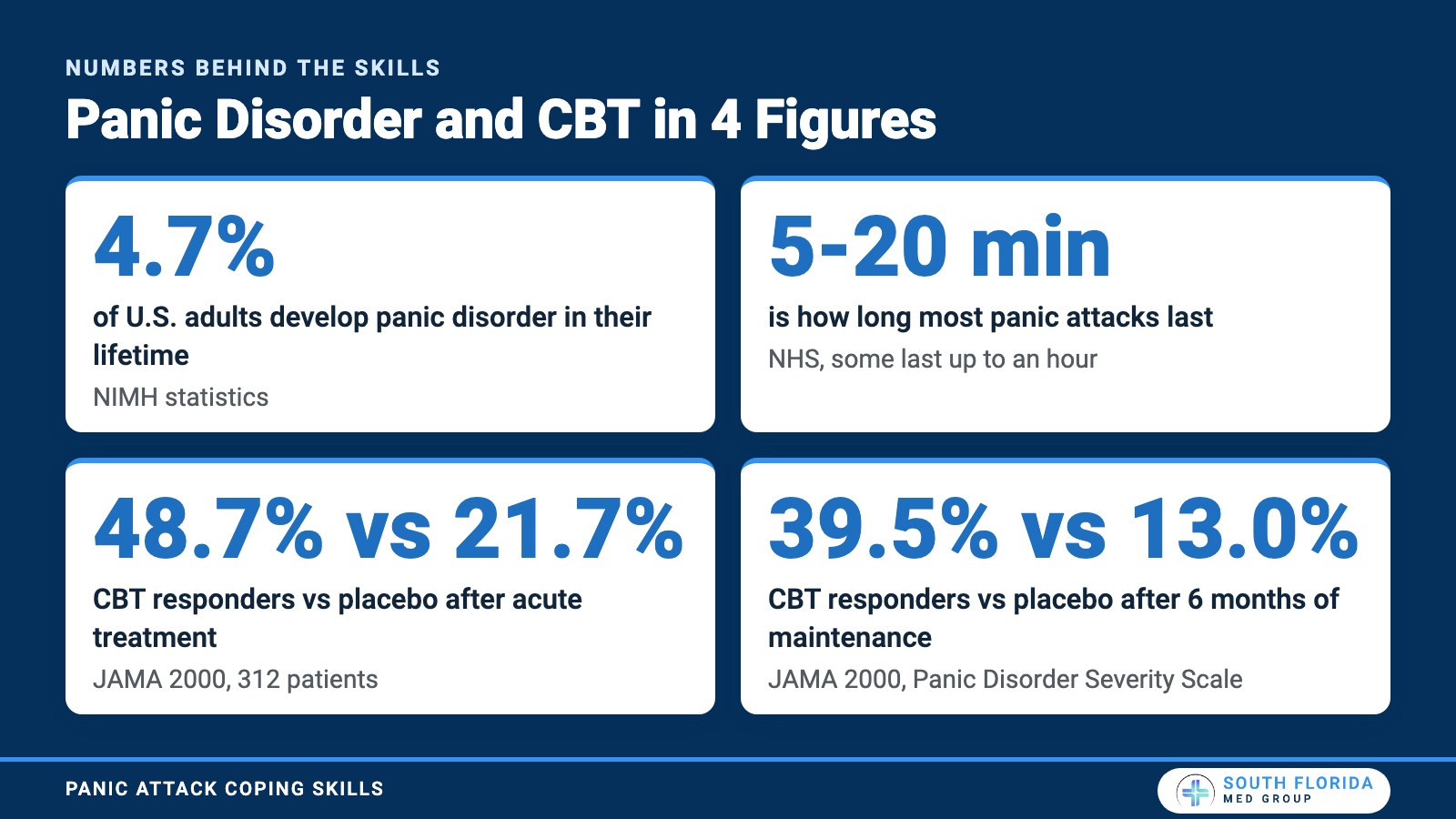
The evidence is specific. In the 2000 JAMA trial of 312 patients, led by Barlow, CBT beat placebo on the Panic Disorder Severity Scale. Response rates were 48.7% for CBT and 21.7% for placebo after acute treatment. After 6 months of maintenance, the rates were 39.5% and 13.0%. The authors reported that CBT appeared durable in follow-up.
A 2016 Cochrane review pooled 54 studies and 3,021 patients. The reviewers found CBT was the most studied therapy and often superior. The effect size was small, and the evidence was low quality. The graphic below summarizes the key numbers.
Many formats exist, and a primer on the types of therapy shows where CBT fits. Some people also ask whether skills alone are enough.
Do Panic Attack Coping Skills Work Without Medication?
Yes, coping skills can work without medication, and NIMH lists psychotherapy, medication, or both as treatment choices. In the JAMA trial, CBT alone beat placebo during acute treatment and after 6 months of maintenance. The right choice depends on symptoms, preferences, and medical history.
Antidepressants such as selective serotonin reuptake inhibitors (SSRIs) and serotonin-norepinephrine reuptake inhibitors (SNRIs) also treat panic disorder. NIMH says they may take several weeks to start working, and side effects can include headaches, nausea, or trouble sleeping. Talk to your prescriber before any change, and never stop an SSRI or SNRI abruptly. A routine SSRI medication review keeps the plan current. Medication and skills then work on different timelines.
How Long Do Panic Attack Coping Skills Take to Work?
Coping skills take time to work, and NIMH says both psychotherapy and medication can take some time. Finding the right fit may take trial and error, according to NIMH. Skills improve with repetition, much like a language, and a log shows small gains before attacks stop.
The JAMA trial measured response after acute treatment and again after 6 months, so benefits were tracked over months, not days. Daily practice, even for a few minutes, matters more than long, rare sessions. A therapy timeline sets expectations for the first weeks. Some people need more than skills, which leads to the next question.
When Are Coping Skills Not Enough?
Coping skills are not enough when attacks keep returning, avoidance grows, or daily life shrinks. NIMH reports that 44.8% of adults with panic disorder had serious impairment, while 29.5% had moderate and 25.7% had mild impairment. Panic disorder involves repeated unexpected attacks and at least 1 month of worry about more attacks.
A clinician rules out other causes, such as thyroid or heart problems, before confirming panic disorder. A structured panic disorder assessment covers symptoms, history, and medical review. Call 911 or go to the nearest emergency room for chest pain, fainting, shortness of breath, or thoughts of self-harm. The 988 Suicide and Crisis Lifeline answers by call or text at 988.
Ongoing attacks respond to treatment, and panic disorder care combines skills, therapy, and medication when needed.
What Else Should You Know About Panic Attack Coping?
Are Panic Attacks Common?
Yes, panic disorder affects an estimated 2.7% of U.S. adults in a given year and 4.7% over a lifetime, according to NIMH. Past-year rates are 3.8% for females and 1.6% for males. Panic disorder often begins in the late teens or early adulthood.
Can Panic Attacks Be Avoided?
Panic attacks cannot always be prevented, but skills can make them less frequent. NIMH says CBT can reduce attack frequency once a person learns to react differently to sensations. Sleep, exercise, and less caffeine lower the odds further.
How Long Does a Panic Attack Last?
Most panic attacks last 5 to 20 minutes, and some last up to an hour, based on NHS information. Knowing attack duration helps a person wait out the peak.
How Do You Cope With Panic Attacks at Work?
Cope with panic attacks at work by stepping away to a quiet room or restroom, grounding your senses, and breathing out slowly. A short script for a manager helps, such as asking for ten minutes. Return to the task after the fear rating drops.
How Do You Cope With Panic Attacks at Night?
Cope with panic attacks at night by sitting up, turning on a low light, and grounding with the 5-4-3-2-1 exercise. Slow breathing with a longer exhale settles the heart. Poor sleep fuels more attacks, so a steady bedtime and less evening caffeine support recovery.
How Do You Cope With Panic Attacks While Driving?
Cope with panic attacks while driving by turning on hazard lights, pulling over at the first safe spot, and breathing slowly. Stay parked until the peak passes and your hands feel steady. Avoid driving through an attack.
How Can You Help Someone Else Cope With a Panic Attack?
Help someone else cope by staying calm, speaking in short sentences, and breathing slowly with them. Do not argue with the fear or tell the person to calm down. This guide to helping someone gives scripts.
Do Coping Skills for Teens and Kids Differ?
Teens and kids use the same core skills, explained in simpler words and practiced with a parent. NIMH reports that 2.3% of adolescents aged 13 to 18 had panic disorder in its adolescent survey. A licensed clinician adapts the plan to age.
Frequently Asked Questions
What Are the Criteria for Panic Disorder in the DSM-5?
The DSM-5 is the manual clinicians use to diagnose mental health conditions. Panic disorder requires recurrent unexpected panic attacks. A diagnosis also needs 1 month or more of worry about further attacks, or a behavior change because of them. A clinician confirms the diagnosis after an evaluation.
What Is the Test for Panic Disorder?
No single lab test confirms panic disorder. A clinician diagnoses it through a structured interview about symptoms and history. A medical review rules out thyroid, heart, or medication causes.
What Are 5 Signs of Panic Disorder?
NIMH lists five signs of panic disorder. The first two are sudden repeated panic attacks and a feeling of being out of control. Fear of death or doom during an attack and intense worry about the next one are signs three and four. The fifth sign is avoidance of places where attacks occurred.
How Can I Cope With Anxiety?
Cope with anxiety by combining slow breathing, regular movement, steady sleep, less caffeine and alcohol, and therapy. CBT teaches skills that work for ongoing worry and panic. A clinician can match the plan to your symptoms.
What to Say to Someone Having a Panic Attack Over the Phone?
Say short, steady lines that promise safety and say the attack will pass. Breathe slowly out loud so the person can match you, and ask what they can see or hear. Call 911 for chest pain, fainting, or trouble breathing.
Can Panic Attacks Cause Chest Pain?
Yes, panic attacks can cause chest pain, and a Cochrane review lists racing heart, chest pain, sweating, and shaking among the symptoms. Chest pain still needs medical attention the first time it occurs. Call 911 or go to the nearest emergency room.
How Does South Florida Med Group Help With Panic Attack Coping Skills?
South Florida Med Group helps patients build panic attack coping skills through psychotherapy, mental health evaluation, and medication management. Stephanie Cabrera, DNP, PMHNP-BC, FNP-BC, leads care. We start with a full evaluation and then teach CBT-based breathing, grounding, and thought-testing skills at a pace that fits each person.
Visits take place in person at our Hialeah office, serving Miami Lakes, or by telehealth. Medication is considered when clinically appropriate, with follow-up reviews. The office is open Monday to Friday, 10 AM to 6 PM, and the phone number is (786) 860-8844.
New patients start by describing their attacks, and South Florida Med Group builds the skill plan from there.