

Panic attack treatment at home works as a daily plan, not a single trick. Guided self-help cognitive behavioral therapy (CBT), slow breathing practice, exercise, steady sleep and less caffeine form the core. A 2023 review of 74 trials found guided self-help beat usual care. Home care has limits, so attacks that keep returning need a clinician to review the plan.
Key Takeaways
- A home plan combines guided CBT, breathing practice, exercise, sleep and caffeine limits.
- A 2023 review of 74 trials found guided self-help CBT beat treatment as usual.
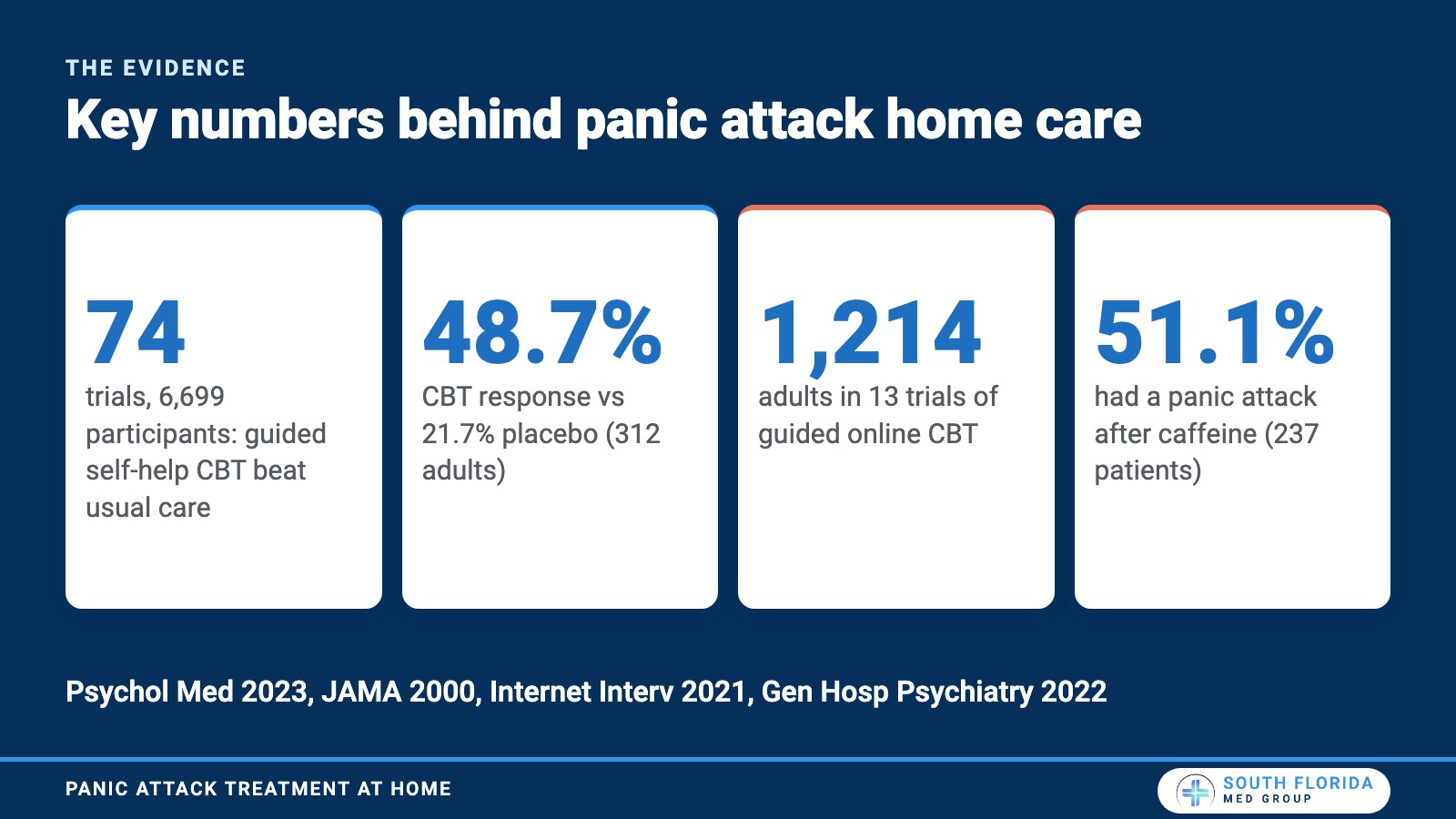
- Caffeine triggered a panic attack in 51.1% of 237 patients across nine trials.
- Home care supports treatment but cannot replace it, according to the National Institute of Mental Health (NIMH).
- Chest pain, trouble breathing or fainting calls for 911 or the nearest emergency room.
What Does Panic Attack Treatment at Home Involve?
Panic attack treatment at home involves a daily plan of guided CBT, breathing, exercise, sleep and caffeine limits, not one response. The National Institute of Mental Health (NIMH) says healthy habits help combat panic disorder but cannot replace treatment. A home plan therefore supports clinical care.
NIMH reports that 2.7% of U.S. adults have panic disorder in a given year and 4.7% have it at some point in life. Those figures describe repeated attacks, not a single episode. A written panic attack treatment plan turns daily habits into a schedule. A clinician-reviewed panic treatment plan keeps that schedule on track.
Do Panic Attacks Go Away on Their Own?
Yes, a single panic attack ends on its own within minutes, but repeated attacks call for treatment. NIMH says an attack lasts a few minutes to an hour or longer. Cleveland Clinic reports that symptoms peak within 10 minutes. The attack passes even without any technique.
Panic disorder behaves differently from one attack. NIMH defines it as recurrent, unexpected attacks followed by at least 1 month of worry about more attacks. The NHS notes that untreated panic disorder can escalate and raise the risk of agoraphobia, alcohol problems or drug problems. Treatment therefore starts with a clear plan.
How Do You Treat Panic Disorder at Home Step by Step?
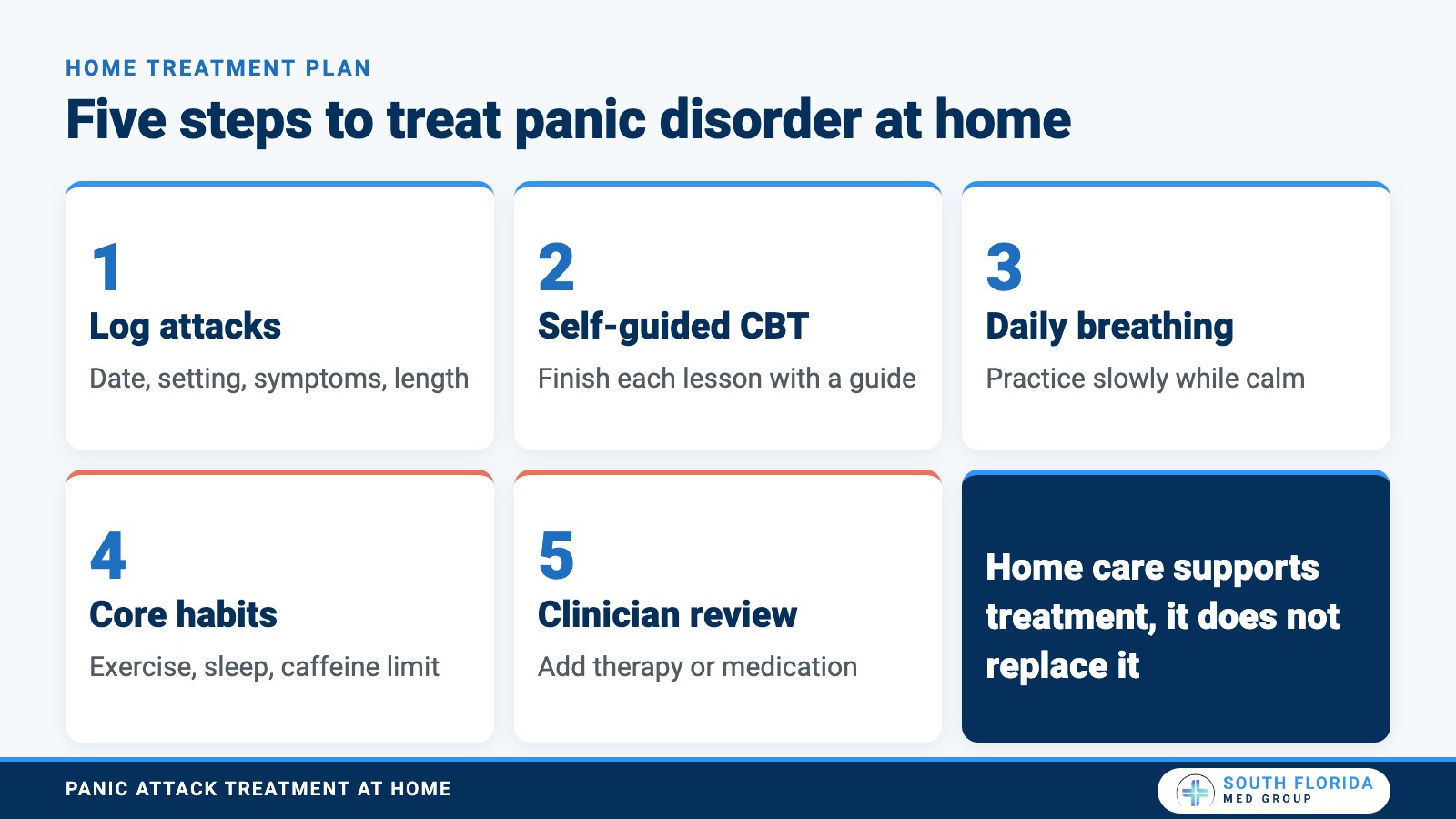
Treat panic disorder at home by following five steps in order. The sequence starts with a symptom log and ends with a clinician review. Each step builds on the one before it. The steps below combine NIMH, NHS and Cleveland Clinic self-care guidance.
- Record every attack in a log with the date, setting, symptoms and length.
- Start a CBT-based self-help program or workbook and finish each lesson.
- Practice slow breathing once a day while calm, before an attack starts.
- Set a weekly exercise routine, a fixed sleep schedule and a caffeine limit.
- Bring the log to a clinician and decide whether therapy or medication should be added.
The log in step one gives a clinician exact attack counts instead of memory. That record also shows whether the other steps are working. The next section explains the second step, self-guided CBT.
Does Self-Guided CBT Work for Panic Attacks?
Yes, guided self-help CBT works for panic disorder, while unguided self-help has weaker evidence. A 2023 network meta-analysis in Psychological Medicine pooled 74 trials with 6,699 participants. Guided self-help beat treatment as usual with a standardized mean difference (SMD) of -0.42. Unguided self-help, at -0.21, did not.
CBT teaches a person to change the thoughts and behaviors that follow body sensations such as a racing heart. NIMH calls CBT the "gold standard" psychotherapy for panic disorder. A 2000 JAMA trial of 312 adults found a 48.7% response to CBT in the acute phase versus 21.7% on placebo.
Interoceptive exposure is a CBT method that practices feared body sensations on purpose, so they lose their threat. A therapist usually guides that step. Working with a clinician in CBT therapy adds the structure that self-help alone lacks.
The Cochrane Collaboration reviewed 54 studies with 3,021 patients in 2016. CBT was the most studied approach, though the review rated the evidence as low quality. Self-guided programs therefore need a guide who checks progress. Online formats offer one way to add that guide.
Do Online Therapy and Apps Help With Panic Attacks?
Yes, guided online CBT helps panic attacks about as much as other active CBT formats. A 2021 meta-analysis in Internet Interventions covered 13 randomized trials with 1,214 adults. Researchers found no significant difference between guided internet CBT and active CBT interventions. Guided programs also beat inactive controls by a large margin.
NIMH states that psychotherapy works in person or virtually via telehealth. Providers may also add apps or other digital tools to therapy. An app alone is not treatment, but an app paired with a clinician extends the work between sessions. Live video visits bring a clinician into the home plan.
Panic attack treatment online suits people who avoid travel because of panic. Avoidance is a core feature of panic disorder, so remote care lowers one barrier. Breathing practice is the next skill that home care and therapy share.
Which Breathing Practice Helps Panic Attacks Over Time?
Slow, diaphragmatic breathing practiced daily is the breathing practice with trial support for panic disorder. A 2010 trial by Meuret and colleagues enrolled 41 panic patients in 4 weeks of capnometry-assisted respiratory training. Their carbon dioxide levels moved from low to normal. Low carbon dioxide from over-breathing is one body change linked to panic symptoms.
A 2018 review in Frontiers in Human Neuroscience screened 2,461 abstracts and kept 15 studies. Breathing under 10 breaths per minute raised heart rate variability, a marker of a calmer nervous system. A longer exhale than inhale is the common pattern in these programs.
Practice works best when the body is calm, because skill builds before stress arrives. Short daily sessions take the place of a rescue technique. A separate guide on calming panic attacks covers what to do in the moment. Exercise is the next habit with trial data.
Does Exercise Help Panic Attacks?
Yes, regular aerobic exercise reduced panic symptoms versus placebo, but it worked less well than medication in one trial. A 1998 study in the American Journal of Psychiatry randomized 46 outpatients to 10 weeks of running, clomipramine or placebo. Clomipramine improved symptoms earlier and more effectively than exercise.
The exercise group still improved significantly over placebo on all main measures. Dropout reached 31% in the exercise group and 27% on placebo. Exercise therefore helps, but sticking with it takes planning.
The NHS lists regular physical exercise to reduce stress and tension, plus yoga and pilates for relaxation. A physical health check before starting a new program confirms that exercise is safe. Caffeine can undo some of that progress.
How Do Caffeine and Alcohol Affect Panic Attacks?
Caffeine and alcohol can make panic attacks worse, according to the NHS and Cleveland Clinic. A 2022 meta-analysis in General Hospital Psychiatry pooled nine placebo-controlled studies with 237 patients. Of those patients, 51.1% had a panic attack after caffeine and none had one after placebo.
The doses in those studies ranged from 400 to 750 mg, roughly 5 cups of coffee. The FDA cites 400 mg a day as an amount not generally associated with negative effects. That equals about 2 to 3 twelve-ounce cups of coffee. People with panic disorder may react at lower amounts, so a clinician can set a personal limit.
Tea, soda and energy drinks also contain caffeine, so the log from step one should track them. The NHS also says sugary food and drinks and smoking can make attacks worse. Sleep is the last habit in the core plan.
How Much Sleep Helps With Panic Attacks?
Adults need 7 to 8 hours of sleep a day, according to the National Heart, Lung, and Blood Institute (NHLBI). NIMH lists enough sleep, exercise, a healthy diet and trusted support as the habits that combat panic disorder. Cleveland Clinic lists sleep problems among the reasons to call a provider.
A fixed wake time, a dark room and no caffeine late in the day support that target. Sleep loss is a stressor, and stress feeds panic. The table below ranks each home strategy by the evidence behind it.
What Helps With Panic Attacks Naturally?
Guided self-help CBT, slow breathing, aerobic exercise, caffeine limits and steady sleep are the natural strategies with research support. The table below shows what each one targets, the evidence behind it and its main limit.
| Strategy | What it targets | Evidence | Main limit |
|---|---|---|---|
| Guided self-help CBT | Thoughts and fear of body sensations | 74 trials, SMD -0.42 vs usual care | Needs a guide to check progress |
| Online CBT with a clinician | Panic symptoms and avoidance | 13 trials, 1,214 adults | Needs a live clinician |
| Slow breathing practice | Over-breathing and low carbon dioxide | 41 patients, 4 weeks | Small trials |
| Aerobic exercise | Stress and tension | 46 patients, 10 weeks | Less effective than clomipramine |
| Caffeine limits | Chemical trigger for attacks | 237 patients, 51.1% attacked | Lab doses were 400 to 750 mg |
| Steady sleep | Stress and recovery | NHLBI: 7 to 8 hours for adults | No panic-specific trial cited |
The table shows that CBT carries the strongest evidence and that every habit has a limit. Habits lower stress but do not replace therapy. That gap raises the question of whether panic attacks can stop for good.
Can Panic Attacks Go Away for Good?
Yes, panic attacks can stop with treatment. Cleveland Clinic reports that most people with panic disorder who get treatment get better. A lasting result needs ongoing care, because the evidence shows gains over months rather than overnight.
The 2000 JAMA trial tracked 312 adults for 6 months of maintenance. A 39.5% response rate on CBT compared with 13.0% on placebo. That gap shows CBT gains continuing after the acute phase. A clinician-built panic anxiety care plan keeps those gains in place.
The Cochrane review adds a limit. Psychological therapies showed a small effect on a low-quality evidence base. Honest expectations therefore matter more than promises. Some situations need more than a home plan.
When Is Home Care Not Enough for Panic Attacks?
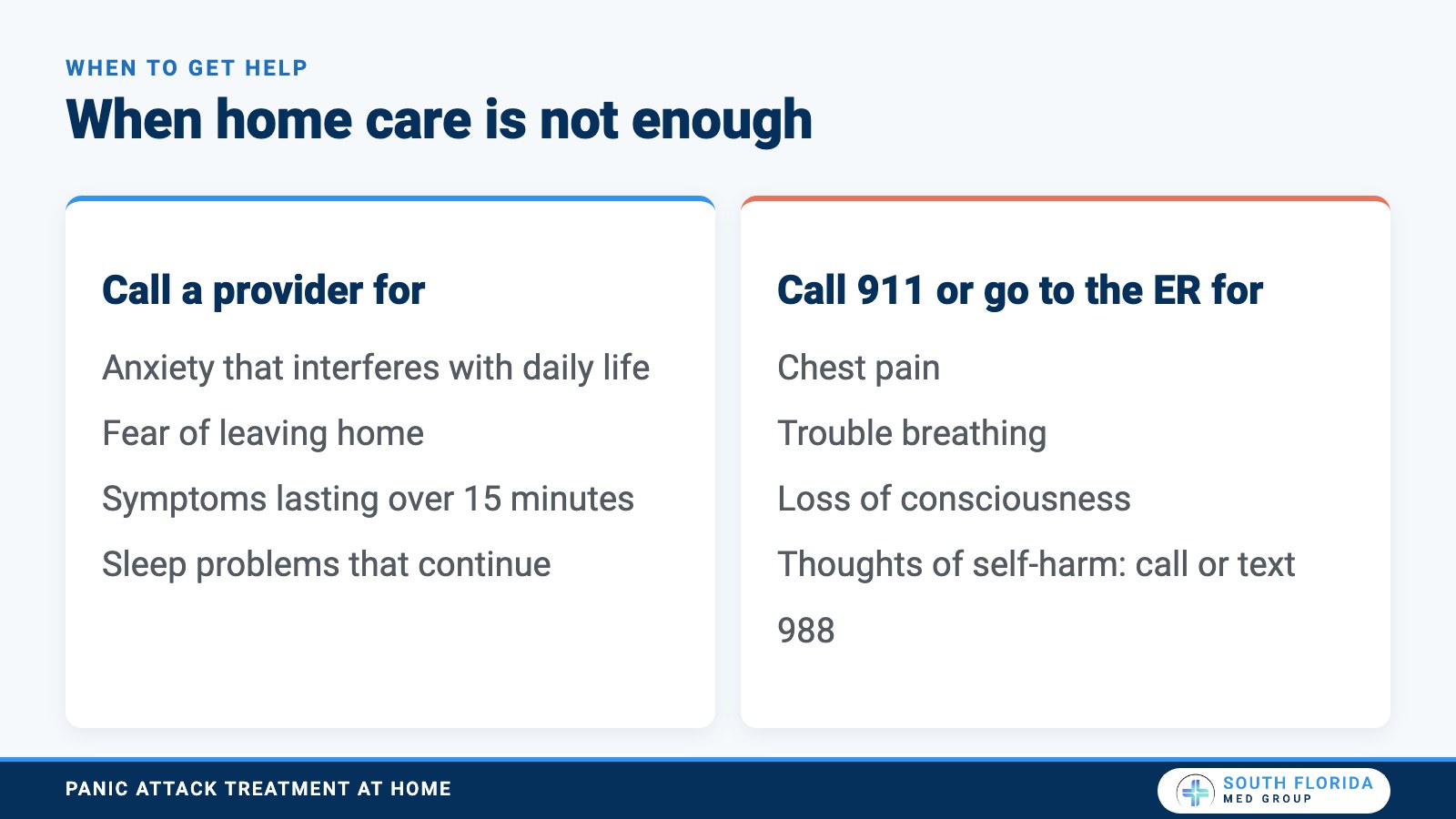
Home care is not enough when attacks keep returning or start to limit daily life. Cleveland Clinic lists these signs that call for a healthcare provider.
- Chronic anxiety that interferes with daily life.
- Difficulty concentrating or extreme irritability.
- Fear of leaving home, called agoraphobia.
- Panic symptoms that last longer than 15 minutes.
- Sleep problems that continue.
Chest pain, trouble breathing or loss of consciousness calls for 911 or the nearest emergency room. A first panic attack with those symptoms also calls for emergency evaluation, because the heart can cause similar signs. A guide on panic heart risk explains the difference.
Cleveland Clinic also reports that untreated panic disorder carries a higher risk of suicidal thoughts. Call or text 988, the Suicide and Crisis Lifeline, at any hour for thoughts of self-harm. Medication is the next option clinicians weigh.
What Medication Treats Panic Disorder?
Panic attack medication falls into three main classes: antidepressants, anti-anxiety medications and beta-blockers, according to NIMH. A prescriber chooses among them based on symptoms, history and other medicines. The table below compares the classes.
| Class | Examples | Role | Key caution |
|---|---|---|---|
| SSRIs and SNRIs | Fluoxetine (Prozac), paroxetine (Paxil), venlafaxine (Effexor) | Reduce attack frequency over weeks | Never stop abruptly without your prescriber |
| Benzodiazepines | Alprazolam (Xanax), lorazepam (Ativan) | Rapid symptom relief | Tolerance and dependence, short-term use |
| Beta-blockers | Propranolol | Physical symptoms such as fast heart rate | Off-label for anxiety; do not stop abruptly |
The table shows that each class has a different timeline. The NHS reports that antidepressants take 2 to 4 weeks to start and up to 8 weeks to work fully. The Zoloft (sertraline) label lists a 25 mg daily starting dose for panic disorder, which a prescriber adjusts.
NIMH says benzodiazepines can rapidly reduce panic symptoms but may cause tolerance and dependence, so providers prescribe them only for brief periods. Beta-blockers are not approved for anxiety and are used off-label. Careful medication plans include scheduled reviews and safe tapering. A medical visit starts that process.
What Will a Doctor Do for Panic Attacks?
A doctor first asks about symptoms, how often they occur and how long they last, according to the NHS. The doctor may also carry out a physical exam to rule out other conditions that cause similar symptoms. Panic disorder is diagnosed after regular, unexpected attacks plus at least a month of worry about more attacks.
A structured panic evaluation reviews symptoms, medical history and triggers. The result shapes the treatment plan, which may combine therapy, medication or both. NIMH notes that finding the right plan may take trial and error.
The NHS adds that a doctor may refer a patient to a psychiatrist or clinical psychologist when symptoms do not improve. A guide on how providers decide on medication explains that step. Several side questions come up along the way.
What Else Should You Know About Home Care for Panic Attacks?
How Long Do Panic Attacks Usually Last?
Most panic attacks last 5 to 20 minutes, and some last up to an hour, according to the NHS. Cleveland Clinic reports that symptoms peak within 10 minutes. A full guide on panic attack duration explains what changes the timeline.
Do Panic Attacks Need Medical Attention?
A panic attack needs medical attention when symptoms are new, severe or last longer than 15 minutes, according to Cleveland Clinic. Chest pain, trouble breathing or loss of consciousness calls for emergency care. NIMH states that panic attacks are not life-threatening, but only an exam can rule out other causes.
Does Holding Your Breath Help With Panic Attacks?
The NHS and Cleveland Clinic both describe slow, deep breathing rather than breath holding for panic attacks. Over-breathing lowers carbon dioxide, and slow breathing corrects that pattern. A clinician can teach a pattern that suits the person.
Can You Take Anything for Panic Attacks?
Yes, prescription options exist, and a prescriber decides which one fits. Cleveland Clinic advises talking to a provider before taking herbal supplements or over-the-counter products, because certain substances can raise anxiety. A guide on treatment without medication covers panic attack treatment without medication in detail.
Frequently Asked Questions
What Are the Symptoms of a Panic Attack According to the NHS?
The NHS lists a racing heartbeat, sweating, trembling, nausea, dizziness and shortness of breath. Other symptoms include chest pain, numbness or tingling, chills and a fear of dying. The NHS adds that many of these symptoms can also come from other conditions.
How Can I Cope With Anxiety Day to Day?
Coping with anxiety day to day starts with sleep, exercise, a healthy diet and trusted support, according to NIMH. The NHS adds a CBT-based self-help book, yoga and less caffeine, alcohol and sugar. A clinician can add therapy when these habits are not enough.
Does a Panic Attack Need Treatment?
Panic disorder needs treatment, while one isolated attack may not. The NHS says untreated panic disorder can become very difficult to cope with. Psychotherapy, medication or both are the main treatments, according to NIMH and Cleveland Clinic.
What Is the Most Effective Medication for Treating Anxiety?
No single medication is the most effective for everyone, and a prescriber matches the choice to the person. NIMH describes SSRIs and SNRIs as the usual starting point for panic and social anxiety because they have fewer side effects. Never stop these medicines abruptly without your prescriber.
What Is the Difference Between a Panic Attack and Panic Disorder?
A panic attack is a sudden episode of intense fear with physical symptoms. Panic disorder means recurrent, unexpected attacks followed by at least 1 month of worry about more attacks, according to NIMH. Only a clinician can diagnose panic disorder.
Can Support Groups Help With Panic Attacks?
The NHS says speaking with other people who have panic disorder might help. Support groups add connection, but they do not replace therapy or medication. A GP can point to local groups.
How Does South Florida Med Group Help With Panic Attacks?
We help with panic attacks through evaluation, psychotherapy and medication management with Stephanie Cabrera, DNP, PMHNP-BC, FNP-BC. Visits take place in person at our Hialeah office or by telehealth. A home plan works well alongside that clinical care.
New patients can start with the intake process, which collects symptoms, history and goals before the first visit.
Call (786) 860-8844, Monday to Friday, 10 AM to 6 PM, to schedule a visit. The team at South Florida Med Group reviews the symptom log together with each patient.