
.png)
.png)
.png)



.png)
.png)
.png)
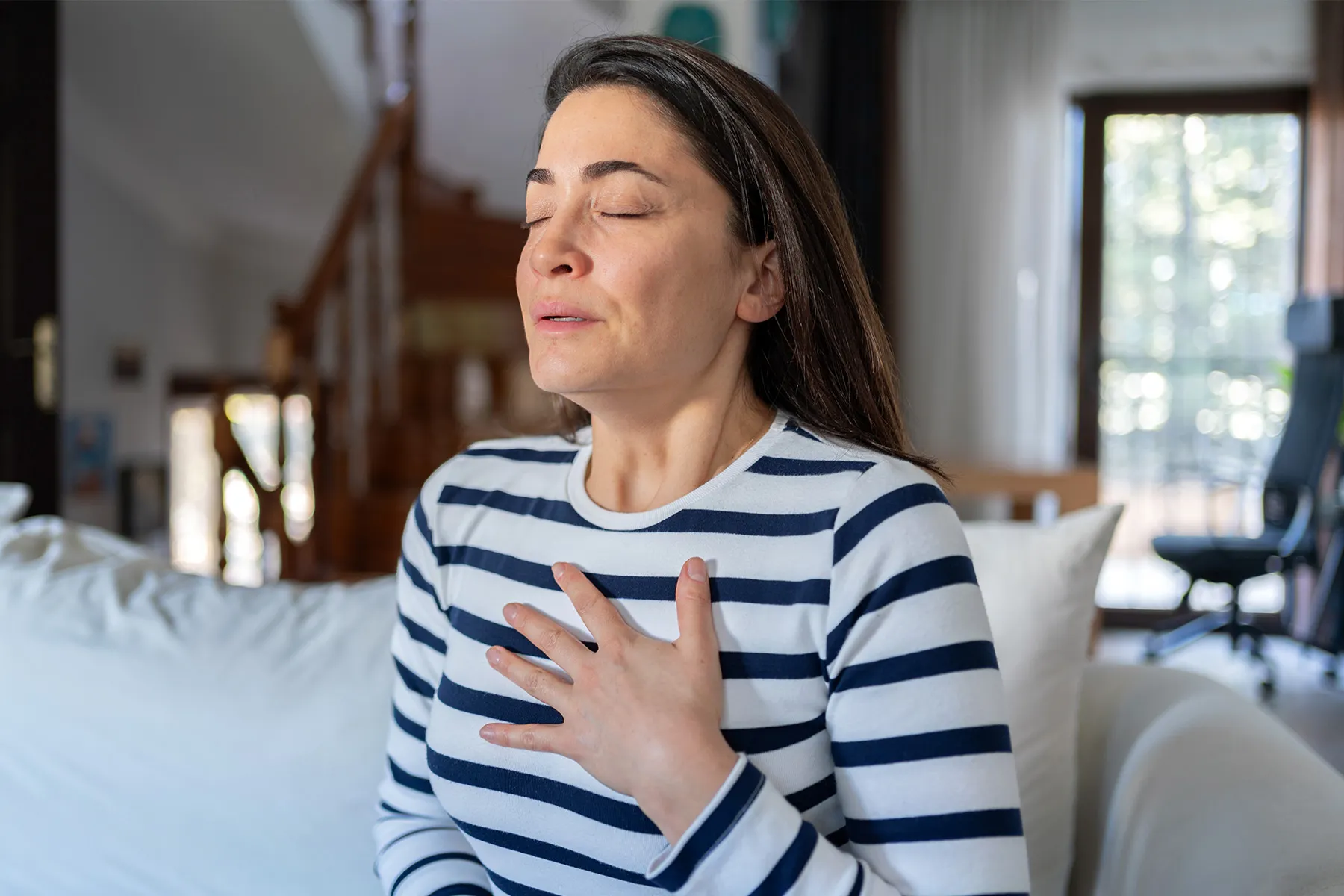
A panic attack feels like a sudden surge of intense fear paired with physical symptoms that arrive all at once: a pounding heart, tightness or pain in the chest, shortness of breath, dizziness, trembling, and a strong sense that something terrible is about to happen. Most attacks peak within about ten minutes and pass within twenty, according to NHS guidance, though some have been reported to last up to an hour.
Below we cover what the experience is like from the inside, how long it lasts, how it compares to a heart attack and why that comparison needs care, the quieter versions people miss, the exhaustion that follows, what actually helps in the moment, and the point at which one attack becomes something worth treating.
What Does a Panic Attack Feel Like?
A panic attack feels like your body has decided you are in mortal danger while your mind can find no reason why. The National Institute of Mental Health describes it as a sudden wave of fear or discomfort or a sense of losing control, occurring even when there is no clear danger or trigger.
The absence of a trigger is what makes the experience so disorienting. There is no threat to point at, so the mind searches for one and often lands on the body itself: this must be a heart attack, a stroke, or the moment something goes permanently wrong. That interpretation feeds the fear, which feeds the physical symptoms, which confirms the interpretation.
Confirmation of that kind is why people describe panic attacks as feeling far longer than the clock says. Many patients we see for anxiety treatment report the first attack as the most frightening experience of their life, and they are not exaggerating for effect.
What Does a Panic Attack Feel Like Physically?
Physically, a panic attack produces a cluster of symptoms that appear together within minutes:
- A pounding, racing, or irregular-feeling heartbeat
- Chest pain or tightness, often described as pressure or a band around the ribs
- Shortness of breath or a choking sensation
- Dizziness, lightheadedness, or feeling faint
- Trembling or shaking limbs
- Sweating, chills, or hot flushes
- Numbness or tingling, typically in the hands, feet, or around the mouth
- Nausea or a churning stomach
- Dry mouth
- A sense of detachment from your body or surroundings
Detachment is the symptom people find hardest to describe afterward, and it is also the one most often left off symptom lists. Both NHS and NIMH include it, and it accounts for the common report that the room looked wrong or that the person was watching themselves from outside.
Why Does a Panic Attack Feel Like Dying?
A panic attack feels like dying because the body is running the same alarm response it would run during genuine physical danger, and that response includes a fear of death as a built-in feature. NIMH lists a fear of death or impending doom as a defining symptom rather than an overreaction to the other symptoms.
Overreaction implies a choice, and there is none available in the moment. NIMH describes panic attacks as false alarms, where the body's ordinary survival instincts fire too often or too strongly. The alarm system is working exactly as designed; it has simply been triggered by nothing.
How Long Do Panic Attacks Usually Last?
Panic attacks usually last between 5 and 20 minutes, according to NHS guidance, with the peak intensity typically arriving within the first ten. Some attacks have been reported to last up to an hour, and NIMH notes they can range from a few minutes to an hour or occasionally longer.
Longer episodes are usually a different shape than they appear. What often feels like a two-hour attack is a shorter surge followed by a long stretch of residual anxiety, elevated heart rate, and dread about a second attack. The distinction matters, because the peak genuinely does pass on its own and cannot be sustained indefinitely by the body.
Frequency varies enormously between people. NIMH reports attacks occurring as often as several times a day or as rarely as a few times a year, and NHS notes that some people have attacks once or twice a month while others have several a week.
Can You Feel a Panic Attack Coming On?
Yes, many people can feel a panic attack coming on. Common early signals include a subtle shift in breathing, a tightening in the chest or throat, sudden restlessness, a wave of unreality, or a jolt of dread with no accompanying thought. These warning signs typically arrive seconds to a few minutes before the full surge.
Minutes of warning are genuinely useful, though not for the reason people assume. The instinct is to use that window to brace or escape, which usually accelerates the attack. The window works better as a chance to sit down somewhere safe and let the wave arrive rather than fight it, which is covered further below.
Can a Panic Attack Feel Like a Heart Attack?
Yes, a panic attack can feel exactly like a heart attack, and you should not attempt to tell the difference yourself during a first episode of chest pain. Research published in the Journal of Clinical Psychiatry found that between 22% and just over 70% of panic attacks involve chest pain, and a 2024 review in Frontiers in Psychiatry reported that 20% to 35% of emergency department patients presenting with chest pain meet criteria for panic disorder.
Those numbers cut in two directions at once, and both matter. Chest pain is the second most common reason U.S. adults visit an emergency department, accounting for more than 6.5 million visits a year and 4.7% of all visits. More than half of those presentations turn out to be non-cardiac, and about 5% are acute coronary syndrome. At the same time, emergency medicine research estimates that 2% to 5% of patients actually having a heart attack are misdiagnosed and sent home.
Home is the wrong place to sort this out. If you are having chest pain for the first time, get evaluated. A visit that ends in a panic attack diagnosis is a good outcome, not a wasted trip, because it also gives you a clean cardiac workup on file. Ongoing chest symptoms belong in a conversation with primary care where both the cardiac and the psychiatric explanations can be examined properly.
FeaturePanic attackHeart attackStrokeSeizureOnsetSudden, peaks in about 10 minutesCan be sudden or build gradually over minutes to hoursSuddenSuddenDuration5 to 20 minutes typicallyPersists or worsens until treatedPersists until treatedUsually under 3 minutesChest sensationSharp or tight, often shifting positionPressure, squeezing, or heaviness, often steadyNot typicalNot typicalRadiating painUncommonMay spread to arm, jaw, neck, or backNot typicalNot typicalNumbness patternBoth hands, both feet, or around the mouthOften one armOne side of the bodyVariesConsciousnessFully alert, often hyper-alertAlert unless severeMay be alteredOften lost or alteredSpeechNormal, though rapidNormalSlurred or word-finding difficultyAbsent during the eventAfterwardExhausted but orientedSymptoms persistDeficits persistConfusion and memory gap
Sources: National Institute of Mental Health; NHS; Frontiers in Psychiatry, 2024. This table is for general education and is not a substitute for emergency evaluation.
How to Know if It's Just Anxiety or Something Serious
You cannot reliably know on your own whether it is just anxiety or something serious, which is why a first episode of chest pain, one-sided weakness, slurred speech, fainting, or loss of consciousness warrants emergency evaluation regardless of how likely panic seems. Call 911 for any of those.
Those specific signs are the dividing line rather than a general instruction to worry. Once a person has been evaluated, has a known panic disorder diagnosis, and recognizes their own attack pattern, self-identification becomes far more reliable. NHS makes the same point from the other direction, noting that most panic symptoms can also be symptoms of other conditions.
What Is Mistaken for a Panic Attack?
Conditions mistaken for a panic attack include cardiac arrhythmia, thyroid disorders, low blood sugar, asthma, inner ear problems, anemia, and reactions to caffeine, stimulants, or withdrawal from alcohol or other substances. Each can produce racing heart, breathlessness, or dizziness without any anxiety involved.
Involvement of any of these is exactly what a workup is meant to establish or exclude. NIMH notes that a provider may conduct a physical exam specifically to make sure an unrelated physical problem is not causing the symptoms, and NHS describes the same step.
What Could Feel Like a Panic Attack but Isn't?
Things that feel like a panic attack but are not include an overwhelming stress response without the physical surge, a trauma flashback, a vasovagal fainting episode, and a hypoglycemic episode. Each is distinguishable clinically even when they feel similar in the moment.
Moments of that kind are worth telling a clinician about in detail rather than summarizing as a panic attack. A flashback in particular calls for a different treatment approach, since it involves stored memory rather than a false alarm, which we cover in our discussion of stored trauma.
What Is a Silent Panic Attack Like?
A silent panic attack is an attack that produces the internal experience of panic with few outward signs, so nobody nearby notices anything is happening. The person feels the racing heart, the dread, and the detachment while appearing to sit calmly through a meeting.
Meetings, classrooms, and family dinners are where these most often occur, because the social setting suppresses the visible response without touching the internal one. Silent attacks are not milder in what they cost the person; they are simply invisible, which means they go unreported and often untreated for years.
What Does a Mild Panic Attack Feel Like?
A mild panic attack feels like a compressed version of the full experience: a brief surge of heart rate, a wave of unease, some shortness of breath, and a sense of wanting to leave, resolving within a few minutes. Fewer symptoms appear and the intensity stays lower.
Lower intensity leads people to dismiss these as stress rather than count them, which distorts the picture a clinician gets. Mild attacks are still panic attacks and they still belong in the history you give your provider.
How Do You Feel After a Panic Attack?
After a panic attack you typically feel drained, physically weak, shaky, cold, and mentally foggy, sometimes for the rest of the day. This aftermath is a normal part of the event rather than a sign something went wrong or that another attack is coming.
Coming down from a panic attack is genuinely a physical recovery. The attack floods the body with adrenaline and cortisol, sends the heart rate up sharply, and tenses muscles throughout the body for several minutes straight. What follows is the same exhaustion that follows any intense physical exertion, layered onto the emotional cost of having been terrified.
Terror leaves residue too. Many people describe feeling emotionally flat, tearful, or oddly detached for hours afterward, and some report feeling strange for a day or two. All of that is within the ordinary range.
Why Do I Feel Tired After a Panic Attack?
You feel tired after a panic attack because your body just completed a full stress response, burning through energy reserves and leaving elevated stress hormones to clear. Muscle tension alone during a twenty-minute attack is comparable to sustained physical effort.
Effort of that kind has a recovery cost that people do not expect, because nothing visibly strenuous happened. The fatigue usually lifts within a few hours to a day, and rest, food, and water genuinely help rather than merely passing the time.
How to Feel Better After a Panic Attack
To feel better after a panic attack, let your body recover the way it would after physical exertion: drink water, eat something, get warm, and lower demands on yourself for the rest of the day. Gentle movement such as a slow walk helps more than lying still for most people.
Most people also make one predictable mistake afterward, which is spending the following hours analyzing the attack and scanning for signs of the next one. That analysis is the mechanism that produces the next one, which the section below explains.
What Triggers Panic Attacks?
Panic attacks are triggered by accumulated stress, poor sleep, caffeine, alcohol, stimulants, hormonal shifts, trauma reminders, and situations previously associated with an attack, though NIMH emphasizes that many attacks occur with no identifiable trigger at all.
At all is the part that unsettles people most, because a trigger at least offers something to avoid. NHS specifically identifies caffeine, alcohol, sugary food and drink, and smoking as aggravating factors worth reducing. Attacks can also occur during sleep, waking a person from rest with the full physical response already underway.
Underway before you are even conscious is a useful demonstration that panic is not a thinking problem. Panic disorder also frequently co-occurs with depression, PTSD, OCD, bipolar disorder, cardiovascular disease, respiratory disorders, irritable bowel syndrome, and thyroid problems, according to NIMH. When attacks began after a traumatic event, treatment for PTSD symptoms may be the more direct route.
Can Dehydration Cause Panic Attacks?
Dehydration does not cause panic attacks, but it can produce dizziness, a faster heart rate, and fatigue that closely resemble early panic symptoms and can set an attack in motion in someone already prone to them. The same applies to low blood sugar from skipped meals.
Meals and fluids are worth attending to for that reason, though drinking water will not stop an attack once it has started. Water helps during recovery and helps prevent the physical states that make attacks more likely. It is not an intervention.
What Is the #1 Worst Habit for Anxiety?
The single worst habit for anxiety is avoidance. Avoiding places, activities, or sensations that previously accompanied an attack provides immediate relief and reliably makes the anxiety larger over time.
Over time is the key qualifier, because avoidance genuinely works in the short term, which is exactly what makes it so hard to stop. NHS describes the resulting pattern as living in fear of fear, and notes it can add to the sense of panic and cause more attacks. Left unchecked, avoidance can develop into agoraphobia, in which a person fears any situation where escape or help might be difficult.
Why Fighting a Panic Attack Makes It Worse
Fighting a panic attack makes it worse because the effort to stop the sensations tells your brain the sensations are dangerous, which strengthens the alarm rather than quieting it. The struggle is itself a threat signal.
Signals of that kind compound into a self-sustaining loop. A physical sensation appears, you interpret it as dangerous, adrenaline rises in response to the interpretation, the sensations intensify, and the intensification confirms the original interpretation. NIMH describes this as a vicious cycle in which someone feels their heart pounding and assumes they are having a heart attack.
Assumptions are the leverage point, not the sensations, and this is precisely what cognitive behavioral therapy targets. A course of psychotherapy for panic works by changing the response to the sensation rather than by eliminating the sensation.
What Not to Do During a Panic Attack
During a panic attack, do not fight the sensations, hold your breath, breathe rapidly into a paper bag, drive, or flee the situation if you can safely stay. Each of these either intensifies the attack or creates a new problem.
Problems arise particularly with fleeing, because escape teaches the brain that the place was genuinely dangerous and that leaving is what saved you. NHS guidance is to stay where you are if possible. Do not use alcohol or extra medication to cut an attack short. Avoid the physical shock methods that circulate online as well, since they trade one distressing sensation for another without changing the underlying pattern.
How to Accept Anxiety and Not Fight It
You accept anxiety rather than fighting it by letting the sensations be present without arguing with them, without checking whether they are getting worse, and without trying to make them stop. Acceptance here means dropping the struggle, not approving of the experience.
The experience passes faster when nobody is pushing against it. A practical version is to name what is happening in plain terms, note that it will peak and decline, and return attention to whatever you were doing. NHS suggests reminding yourself the attack will pass and that it is not life threatening.
How to Calm an Anxiety Attack
To calm an anxiety attack, slow your breathing, stay where you are, and give the surge time to peak and fall rather than trying to stop it. The following sequence reflects NHS guidance:
- Stay put if it is safe to do so. Sit down if you can. Do not drive.
- Slow your exhale. Breathe in through the nose for a count of four and out through the mouth for a count of six. The longer out-breath is what settles the nervous system.
- Name it. Say to yourself that this is a panic attack, that it peaks in about ten minutes, and that it passes.
- Ground your attention outward. Notice five things you can see, four you can hear, and three you can physically feel against your skin or under your feet.
- Let the sensations be there. Stop monitoring your heart rate and stop checking whether it is working.
- Wait it out. The peak is time-limited and your body cannot sustain it.
- Recover afterward. Water, food, warmth, and a lower-demand rest of the day.
How Do You Talk Yourself Out of a Panic Attack?
You do not talk yourself out of a panic attack so much as talk yourself through it, using short factual statements rather than reassurance-seeking or argument. Statements like "this is panic," "this peaks and passes," and "I have been here before" work better than debating whether you are dying.
Debating that question is a losing game because the fear will always produce another counterargument. Repeatedly seeking reassurance, from yourself or from someone else, tends to strengthen the pattern rather than settle it.
What Calms Anxiety Right Away?
What calms anxiety fastest is slow paced breathing with a longer exhale than inhale, combined with grounding your attention on the physical environment. Both work within minutes and neither requires equipment or privacy.
Privacy matters less than people assume, since both techniques are invisible to anyone nearby. For people with frequent attacks, prescription options exist and are discussed with a provider rather than self-selected, since the fast-acting medications in this category carry dependence risk with regular use.
What Does Severe Anxiety Feel Like?
Severe anxiety feels like a constant background state of threat that does not switch off, with physical tension, disrupted sleep, difficulty concentrating, irritability, and a shrinking range of activities you feel able to do. Panic attacks may sit on top of that baseline or may not appear at all.
Appearing or not, the functional cost is what defines severity rather than the presence of dramatic episodes. Someone with no panic attacks who has stopped driving on highways, stopped eating in restaurants, and sleeps four hours a night has severe anxiety. Our approach to anxiety care starts from what a person has stopped doing rather than from how intense any single moment felt.
What Are Signs That Your Anxiety Is Getting Worse?
Signs that anxiety is getting worse include a widening list of situations you avoid, attacks that come more often or with less warning, worsening sleep, more physical symptoms between attacks, increased alcohol use, and worry about anxiety itself occupying more of the day.
Occupying the day is the most telling of these. When the time spent anticipating anxiety exceeds the time spent actually anxious, the condition has shifted from episodes to a continuous state, and that shift is the point at which treatment tends to produce the clearest benefit.
What Are the Signs That Anxiety Is a Flare-Up?
Signs of an anxiety flare-up are a temporary intensification lasting days to weeks, usually traceable to a stressor, sleep disruption, illness, hormonal change, or a medication change. Flare-ups return toward baseline once the trigger resolves.
Resolution is what distinguishes a flare from a genuine worsening. If symptoms stay elevated after the stressor has passed, or if each flare leaves you at a higher baseline than the last, that pattern is worth raising with a provider rather than waiting out.
What Do People With Panic Disorder Experience?
People with panic disorder experience recurrent unexpected panic attacks plus persistent worry about having another one, often reshaping their lives to avoid situations where attacks happened before. NIMH sets the diagnostic threshold at recurrent unexpected attacks together with at least one month of worry about further attacks, fear about what the attacks mean, or behavior change to avoid them.
One month of that worry is the line between an experience and a disorder. NIMH is explicit that not everyone who has a panic attack develops panic disorder, and that an isolated panic attack is not a mental disorder at all. Roughly 22.7% of people experience a panic attack at some point, while panic disorder has a lifetime prevalence of 3.7%, according to a 2024 review in Frontiers in Psychiatry.
That same review reports something worth sitting with: treatment delay for panic disorder ranges from 9 to 15 years. People live with this for over a decade before anyone treats it, frequently after multiple emergency visits and cardiac workups. Panic disorder also commonly travels with depression, which is why depression care and panic treatment often run together.
Running them together is straightforward once the pattern is named. If you are unsure whether what you are experiencing crosses the threshold, our discussion of seeing a psychiatrist covers that decision.
When Should I Seek Help for Anxiety?
You should seek help for anxiety when it starts causing problems in everyday life, at work, at school, or with friends and family. That is NIMH's own threshold, and it is deliberately lower than most people set for themselves.
Setting the bar higher is the most common mistake, and it is what produces the decade-long delays. You do not need to be in crisis to qualify for care. Specific prompts worth acting on include a second or third attack, avoiding places or activities you used to manage, attacks disrupting sleep or work, using alcohol to cope, or ongoing physical symptoms that have already been medically cleared.
Clearing those symptoms medically first is genuinely useful, and after that a mental health evaluation establishes what is happening and what will help.
What will help depends on details a first visit is built to gather. At our Miami Lakes practice, that visit covers when symptoms began, what an attack looks like for you, what you have started avoiding, and what else is going on medically, since panic overlaps with thyroid, cardiac, and respiratory conditions that deserve ruling out. Structured assessment of panic symptoms is the difference between managing attacks and knowing what drives them.
What Should I Do If I Can't Control My Anxiety Anymore?
If you cannot control your anxiety anymore, that is a reason to contact a provider promptly rather than a sign you have failed at managing it. Anxiety reaching a point where willpower no longer touches it is a well-recognized clinical stage with established treatments.
Established treatment matters more than the feeling of losing ground. If you are having thoughts of suicide or self-harm, call or text 988 to reach the Suicide and Crisis Lifeline, available at any hour, or call 911 in an emergency. Reaching that point does not mean anything about you except that the condition has outgrown what anyone manages alone.
At What Point Should You Be Hospitalized for Anxiety?
Hospitalization for anxiety is uncommon and generally reserved for situations involving risk to your safety, an inability to eat, sleep, or care for yourself, or symptoms severe enough that outpatient care cannot stabilize them. NHS notes it is unlikely you would be admitted to hospital for a panic attack itself.
Itself is the operative word. Most severe anxiety, including frequent daily panic attacks, is treated entirely on an outpatient basis with therapy and medication. If you are wondering whether your situation warrants that level of care, the answer comes from an evaluation rather than from a self-assessment during a bad week.
How to Fight Crippling Anxiety
Crippling anxiety responds to structured treatment rather than to effort, and cognitive behavioral therapy combined with medication has the strongest evidence for panic and severe anxiety. Trying harder is not the missing ingredient.
The ingredient that is usually missing is a plan built around exposure rather than avoidance, delivered with support. Anxiety severe enough to shrink your life is the presentation that treatment was designed for, and it is often the presentation that responds most visibly once treatment begins.
How Is Panic Disorder Treated?
Panic disorder is treated with psychotherapy, medication, or both. NIMH describes cognitive behavioral therapy as the gold standard psychotherapy for panic disorder, teaching different ways of thinking about and reacting to the physical sensations that occur before and during an attack.
Reacting differently is the mechanism, and one CBT technique deserves specific mention because it is so counterintuitive. Interoceptive exposure deliberately reproduces the bodily sensations associated with panic, through methods like brief controlled hyperventilation or spinning, so the fear attached to those sensations can wear off. Practicing the feared sensation on purpose is what breaks its power.
Power over the sensation is also what medication supports. NIMH lists SSRIs and SNRIs as commonly used for panic disorder, taking several weeks to begin working, with NHS putting antidepressant onset at 2 to 4 weeks and full effect at up to 8 weeks. Beta blockers can address physical symptoms in specific situations. Benzodiazepines reduce panic symptoms rapidly, but NIMH notes tolerance and dependence risk and that providers may prescribe them only briefly. Choosing among these is part of ongoing psychiatric care rather than a decision made once at the first appointment.
Appointments after that first one are where most of the adjustment happens, and they work well through virtual visits for people whose anxiety makes travel to an office harder. Patients across Miami Lakes use that option throughout the early months of treatment.
Does Anxiety Get Worse Before It Gets Better?
Anxiety can temporarily increase early in treatment, particularly during exposure-based therapy and during the first weeks on a new medication. This is an expected phase rather than a sign that treatment is failing. Exposure work raises anxiety deliberately and briefly in order to lower it durably.
Durably is the payoff, and knowing the bump is coming makes it far easier to sit through. This is worth discussing with your provider before starting so the first difficult week does not read as evidence that nothing is working.
Frequently Asked Questions
Can a Panic Attack Feel Like a Stroke?
A panic attack can produce numbness, tingling, dizziness, and a sense of unreality that people mistake for a stroke. The distinguishing pattern is that panic-related numbness usually affects both hands, both feet, or the area around the mouth, while stroke symptoms typically affect one side of the body and may include facial drooping or slurred speech. Any sudden one-sided weakness or speech difficulty is a 911 call, not a wait-and-see situation.
Can a Panic Attack Look Like a Seizure?
Severe panic attacks can involve trembling, shaking, and altered awareness that resemble a seizure to onlookers. The main differences are that seizures typically last under three minutes and are followed by confusion and a memory gap, while a person having a panic attack stays oriented and remembers the episode clearly. A first episode involving loss of consciousness needs emergency evaluation.
How to Tell if It's Just a Panic Attack
You can tell it was probably a panic attack if the symptoms peaked within about ten minutes, resolved within twenty, left you exhausted but fully oriented, and matched a pattern you have experienced before. The word "just" is misleading either way. Panic attacks are not dangerous, but they are also not trivial, and recurring ones are worth treating.
Can You Have a Panic Attack in Your Sleep?
Yes, panic attacks can occur during sleep, and NIMH notes they can happen at any time including while asleep. Nocturnal panic attacks wake a person with the physical response already at full intensity, which is particularly disorienting because there is no situation to attribute it to. They respond to the same treatments as daytime attacks.
Are Panic Attacks Dangerous?
Panic attacks are not physically dangerous. NHS states plainly that an attack will not cause you physical harm, and NIMH notes that panic attacks themselves are not life-threatening and the physical symptoms usually resolve with time. What causes lasting damage is the avoidance that builds up around them, which is why treatment focuses there.
What Is the Difference Between a Panic Attack and an Anxiety Attack?
A panic attack is a defined clinical event with sudden onset, a peak within about ten minutes, and a specific symptom cluster. An anxiety attack is not a formal diagnostic term; people generally use it for a period of intense anxiety that builds more gradually and lasts longer without the same abrupt surge. Both are worth reporting to a provider using whatever words feel accurate to you.
What It All Comes Down To
A panic attack is a false alarm delivered at full volume: pounding heart, chest tightness, breathlessness, dizziness, and a genuine conviction that something catastrophic is happening, usually peaking in ten minutes and passing within twenty. The attack itself is not dangerous. What causes the damage over time is the fear of the next one and the steady narrowing of life that follows from avoiding it. Chest pain is the one exception to that reassurance, because a first episode deserves a medical evaluation rather than a self-diagnosis.
Panic disorder is highly treatable, and the average person waits nine to fifteen years before starting treatment that often works within months. If attacks are recurring, if you are avoiding things you used to do, or if the worry about the next attack takes up more room than the attacks themselves, that is enough reason to have the conversation.
At South Florida Med Group, psychiatric and primary care sit under one roof, which means the medical questions and the anxiety questions can be sorted out together rather than in separate appointments months apart.
Sorting them out together tends to be what finally moves things. You are welcome to reach out whenever you feel ready.



.png)

.png)
