


Yes, you can have a panic attack for no reason you can see. The National Institute of Mental Health (NIMH) says these attacks occur out of the blue, and 2.7% of U.S. adults had panic disorder in the past year. The cause is hidden, not missing. Body signals, stress, sleep, and caffeine can trip the alarm. This guide explains the triggers, the criteria for panic disorder, and what helps.
Key Takeaways
- A panic attack with no clear trigger is called an unexpected panic attack, and NIMH says it is not life-threatening.
- The body sets off a false alarm, sometimes after a harmless sensation such as a flutter or a dizzy moment.
- Caffeine, short sleep, skipped meals, alcohol, and built-up stress can all act as hidden triggers.
- Panic disorder needs repeated unexpected attacks plus at least 1 month of worry or behavior change.
- Cognitive behavioral therapy (CBT), medication, or both treat repeated attacks.
Can You Have a Panic Attack for No Reason?
Yes, a panic attack can happen for no reason you can identify. NIMH says these attacks occur out of the blue, not tied to a known fear or stressor. Clinicians call them unexpected panic attacks. The trigger can sit inside the body, such as a racing heart or a dizzy moment.
A single attack does not mean illness. MedlinePlus notes that many people have only one or two panic attacks in a lifetime and recover without treatment. Repeated attacks respond to panic disorder treatment, and the next sections explain why attacks seem random.
What Is an Unexpected Panic Attack?
An unexpected panic attack is a sudden surge of intense fear with no obvious cue. An expected attack follows a known cue, such as a crowd, a flight, or an exam. NIMH describes panic disorder as unexpected and repeated episodes of intense fear with physical symptoms.
The word unexpected describes what you notice, not what your body does. A random panic attack for no reason still involves a body reaction, and that reaction creates the physical symptoms described next.
What Does a Random Panic Attack Feel Like?
A random panic attack feels like a sudden wave of fear with physical symptoms that mimic an emergency. NIMH lists these physical symptoms of a panic attack.
- Pounding or racing heart.
- Sweating and chills.
- Trembling.
- Difficulty breathing.
- Weakness or dizziness.
- Tingly or numb hands.
- Chest pain.
- Stomach pain or nausea.
Cleveland Clinic says symptoms peak within 10 minutes and then fade. NIMH adds that an attack can last from a few minutes to an hour or longer. A guide to panic attack symptoms explains each sign, and all of them trace back to one body reaction.
What Causes a Panic Attack for No Reason?
A panic attack for no reason comes from a false alarm in the body's fight-or-flight system. NIMH explains that researchers think panic attacks are false alarms, where survival instincts switch on too often or too strongly. The brain releases adrenaline, the heart speeds up, and breathing gets faster.
NIMH adds that several parts of the brain and certain biological processes play a role in fear and anxiety. The alarm is real even when the danger is not. Faster breathing, called hyperventilation, adds dizziness and tingling. Genetics and brain chemistry also play a role. MedlinePlus says panic disorder sometimes runs in families, and it lists brain biology, environment, and major stress as contributing factors. Those factors set the baseline, and a small signal then tips it over.
Why Do I Have a Panic Attack for No Reason?
You have a panic attack for no reason when a harmless body sensation is read as danger and fear feeds on itself. A clinical psychologist writing in Psychology Today gives an example. A person feels slightly lightheaded, thinks a panic attack is starting, and becomes anxious.
Anxiety makes dizziness worse, and worse dizziness raises anxiety further. NIMH describes the same vicious cycle, where a pounding heart is mistaken for a heart attack. The first spark is easy to miss, so the attack looks random. A comparison of heart attack symptoms next to panic symptoms shows why that mistake is so easy to make.
What Hidden Triggers Set Off a Panic Attack With No Trigger?
Hidden triggers include caffeine, short sleep, skipped meals, alcohol, built-up stress, and body conditions such as an overactive thyroid. The table below shows six hidden triggers, what each does in the body, and what to note in a trigger log.
| Hidden trigger | Effect on the body | What to track |
|---|---|---|
| Caffeine | Stimulant that speeds the heart and can mimic early panic signs | Cups of coffee, tea, or energy drinks per day |
| Short sleep | MedlinePlus lists enough sleep among habits that support panic care | Hours slept the night before |
| Skipped meals | Low blood glucose causes shaky, jittery feelings and a fast heartbeat | Time of the last meal |
| Alcohol | Cleveland Clinic says alcohol can make panic attacks worse | Drinks in the past 24 hours |
| Built-up stress | MedlinePlus says panic disorder sometimes starts under a lot of stress | Work, family, health, or money pressure that week |
| Overactive thyroid | Causes nervousness, tremor, and a rapid, irregular heartbeat | Needs a blood test from a provider |
The graphic below summarizes the same six triggers on one card for quick reference.
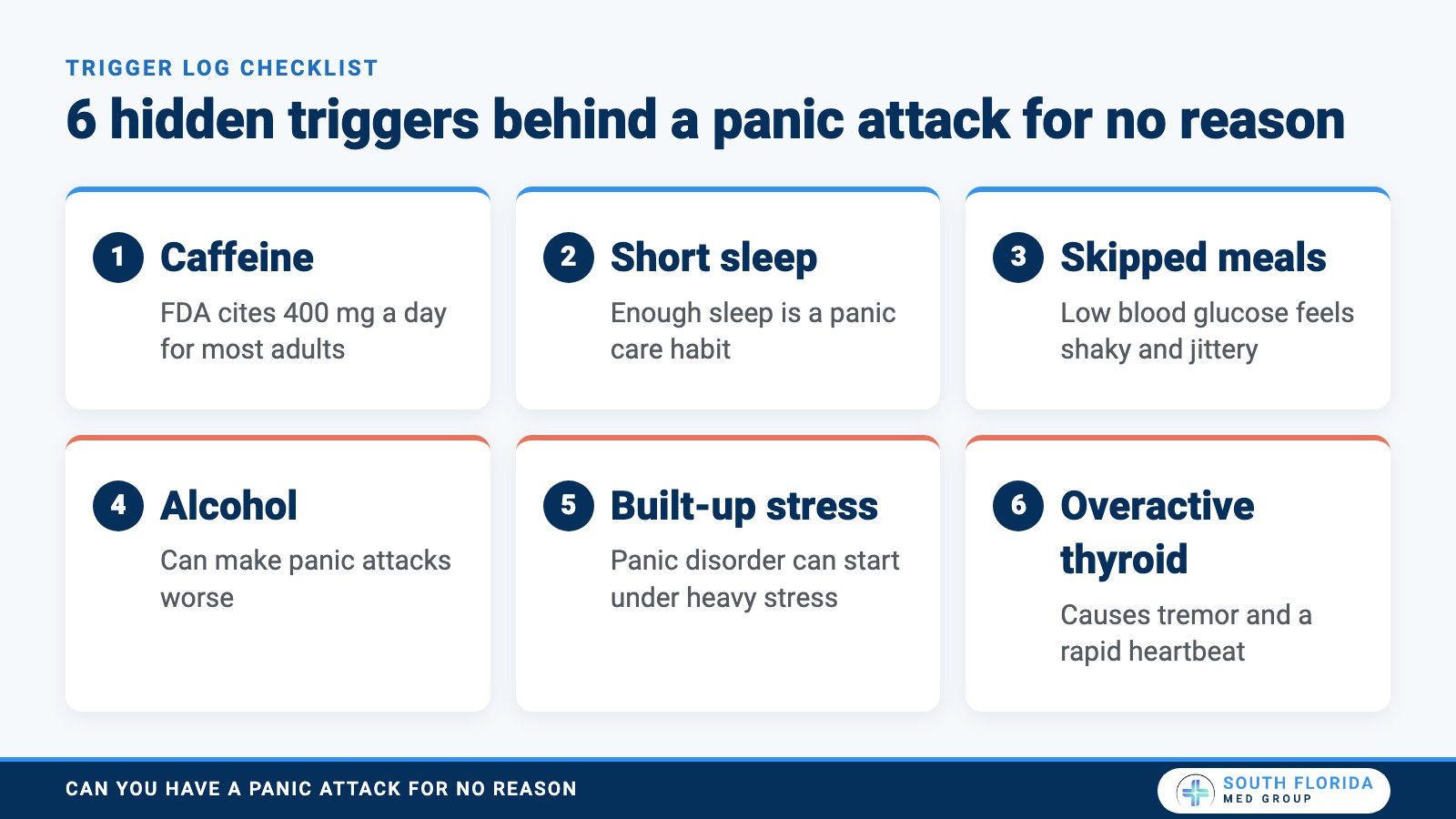
The FDA cites 400 milligrams of caffeine a day as an amount not generally associated with negative effects for most adults. That amount equals about two to three 12-ounce cups of coffee. Sensitivity varies from person to person, so a log shows personal patterns better than a general number.
Can Stress Cause Random Panic Attacks?
Yes, stress can cause random panic attacks by raising tension until a small signal tips the system into alarm. MedlinePlus says panic disorder sometimes starts when a person is under a lot of stress. People who have had trauma, especially in childhood, are more likely to develop it.
Stress that builds for weeks can look like no reason on the day an attack hits. A busy month, a loss, or poor recovery between demands can raise the baseline. The body carries that tension even when the mind has moved on. Stress is one cause, and a medical condition is another.
Can a Medical Condition Cause a Panic Attack for No Reason?
Yes, a medical condition can cause symptoms that feel like a panic attack for no reason. Cleveland Clinic says providers run tests to rule out heart disease, thyroid disease, and breathing problems. MedlinePlus lists nervousness, tremor, trouble sleeping, and a rapid, irregular heartbeat as symptoms of an overactive thyroid.
The National Institute of Diabetes and Digestive and Kidney Diseases (NIDDK) lists shakiness, dizziness, and irritability as signs of low blood glucose. The same list includes a fast or unsteady heartbeat. A medical workup checks these causes with an exam and lab tests.
Chest pain, trouble breathing, or fainting needs urgent care. Call 911 or go to the nearest emergency room for those symptoms. Once serious causes are ruled out, the next question is how common these attacks are.
Are Random Panic Attacks Normal?
Yes, random panic attacks are common. Cleveland Clinic reports that up to 11% of people in the United States have a panic attack each year. Approximately 2% to 3% have panic disorder, and women are two times more likely than men to have it.
Up to 11% have an attack while 2% to 3% have the disorder, so one attack does not equal panic disorder. A common experience still deserves attention when attacks repeat. The line between a single attack and a disorder follows clear criteria.
How Do You Tell a Panic Attack From Panic Disorder?
A panic attack becomes panic disorder when attacks are recurrent and unexpected, with at least 1 month of worry or behavior change. NIMH states the criteria this way. The worry covers more attacks, what the attacks mean, or changes made to avoid them. An isolated panic attack is not a mental disorder.
NIMH reports that 2.7% of U.S. adults had panic disorder in the past year and 4.7% experience it at some time in their lives. Past-year rates were 3.8% for women and 1.6% for men. Anyone asking can you have a panic attack for no reason should count the attacks and the weeks of worry. The table compares the two situations.
| Feature | Single panic attack | Panic disorder |
|---|---|---|
| Number of attacks | One or two in a lifetime for many people | Recurrent attacks |
| Trigger | May have a clear or unclear cause | Attacks are unexpected |
| After the attack | Fear fades | At least 1 month of worry or avoidance |
| Medical label | Not a mental disorder, per NIMH | Anxiety disorder diagnosed by a clinician |
| Care needed | May resolve without treatment | CBT, medication, or both |
The graphic below lays out the same comparison with the NIMH criteria.
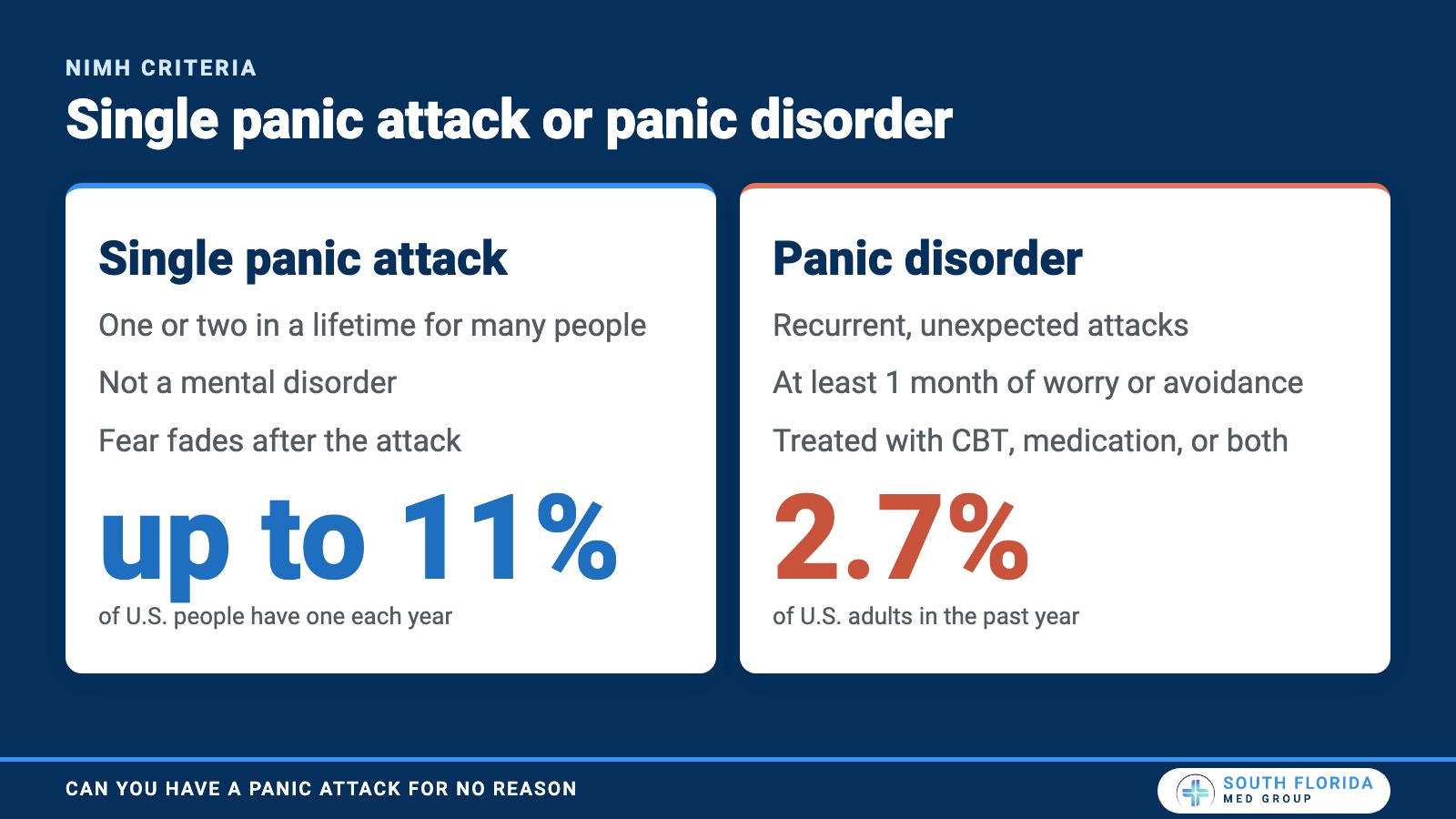
NIMH reports that 44.8% of adults with panic disorder had serious impairment in daily life. MedlinePlus notes that panic disorder often starts in the late teens or early adulthood. Knowing the criteria makes the in-the-moment response easier to plan.
How Do You Stop a Panic Attack for No Reason?
Slow your breathing, name the sensation, and let the wave pass. Follow these five steps when a sudden panic attack for no reason starts.
- Name the attack by saying that this is a panic attack and it will pass.
- Breathe in slowly through the nose and out through the mouth, with a longer exhale.
- Pick one object in view and describe its color, texture, and shape.
- Keep doing what you were doing, because fighting the sensation feeds the cycle.
- Wait out the peak, which Cleveland Clinic places within 10 minutes.
A psychologist writing in Psychology Today advises acting as if the panic were not there, because avoidance maintains anxiety. Pull over before continuing if an attack starts while driving. A guide to calming sudden panic adds more techniques, and prevention keeps the next attack further away.
How Do You Prevent Random Panic Attacks?
Prevent random panic attacks by building steady habits and learning how your body signals work. MedlinePlus lists these healthy habits for panic disorder:
- Avoid alcohol.
- Reduce caffeine.
- Eat regular meals.
- Get enough sleep.
- Exercise regularly.
A trigger log adds a sixth step. Write down sleep, caffeine, meals, and stress level after each attack. A clinician can use the log to guide care. Habits reduce triggers, and therapy removes the fear behind them.
How Are Random Panic Attacks Treated?
Random panic attacks are treated with psychotherapy, medication, or both. NIMH calls CBT the gold standard psychotherapy for panic disorder. CBT teaches a different reaction to the physical sensations of fear. Interoceptive exposure, a CBT method, practices bodily sensations such as a fast heartbeat in a safe setting.
Structured cognitive behavioral therapy breaks the link between a body signal and a feeling of danger. NIMH adds that therapy can be effective in person or by telehealth.
MedlinePlus lists selective serotonin reuptake inhibitors (SSRIs), serotonin-norepinephrine reuptake inhibitors (SNRIs), and other anti-anxiety medicines as options. A prescriber decides which medicine fits and holds an antidepressant review at regular intervals. Never stop an SSRI or SNRI abruptly without talking to your prescriber. The next section covers when a visit becomes the right step.
When Should You See a Provider for Panic Attacks?
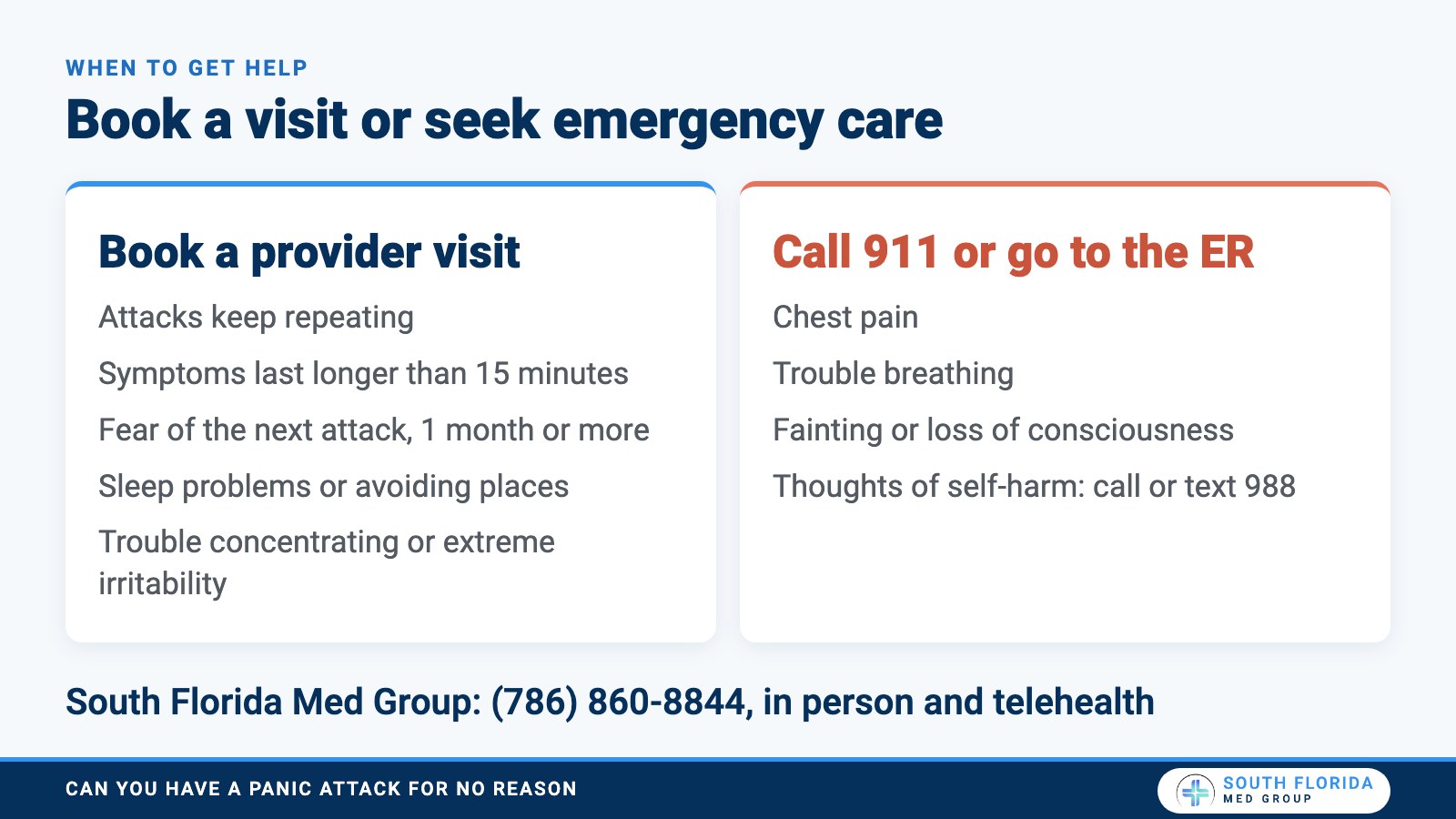
See a provider when attacks repeat, last longer than 15 minutes, or change how you live. Cleveland Clinic lists reasons to call a provider. They include long-lasting anxiety that interferes with daily life, difficulty concentrating, and extreme irritability. Fear of leaving home, symptoms beyond 15 minutes, and sleep problems also count.
Chest pain, trouble breathing, or loss of consciousness calls for emergency care. Call 911 or go to the nearest emergency room. Thoughts of self-harm also need immediate help, so call or text the 988 Suicide & Crisis Lifeline at 988. The graphic below shows when to book a visit and when to seek emergency care.
What Else Should You Know About Random Panic Attacks?
Is a Panic Attack the Same as an Anxiety Attack?
No, a panic attack is not the same as an anxiety attack. Cleveland Clinic says stressors often trigger anxiety attacks and they may build gradually, while panic attacks typically happen unexpectedly and suddenly. Both respond to anxiety attack treatment that targets the same fear cycle.
Can a Panic Attack Happen at Night?
Yes, a panic attack can wake a person from sleep with a racing heart and fear. Night attacks have no daytime cue, so they look random. A clinician reviews sleep habits, caffeine timing, and medical causes together.
Are Women More Likely to Have Random Panic Attacks?
Yes, NIMH reports past-year panic disorder in 3.8% of women and 1.6% of men. Symptoms can look different from person to person, and a guide to panic in women covers the common patterns.
Can Panic Attacks Happen While Driving?
Yes, a panic attack can start while driving because internal body signals need no outside cue. Slow your breathing and pull over at the next safe spot. Wait until the symptoms fade before driving again.
Is It Normal to Be Scared of Having Another Panic Attack?
Yes, fear of another attack is a recognized part of panic disorder. NIMH lists intense worry about when the next attack will happen as a symptom. Avoiding places where attacks occurred can follow, which is why early care matters.
Can Telehealth Help With Panic Attacks?
Yes, NIMH says psychotherapy for panic disorder can be effective in person or virtually. A video visit allows an evaluation and CBT sessions from home. Some patients also combine telehealth with in-person visits.
Frequently Asked Questions
What Is the Test for Panic Disorder?
No single lab test diagnoses panic disorder. A provider asks about symptoms and medical history and may order tests to rule out heart, thyroid, or breathing conditions. NIMH requires recurrent unexpected attacks and at least 1 month of worry or behavior change.
What Not to Do During a Panic Attack?
Do not fight the sensations, flee the situation, or add caffeine or alcohol during a panic attack. Psychology Today explains that avoidance maintains anxiety, and Cleveland Clinic says caffeine and alcohol can make attacks worse. Do not drive until the symptoms pass.
Should You Hug Someone Having a Panic Attack?
Ask first, because touch helps some people and overwhelms others. Cleveland Clinic advises staying with the person, speaking in short simple sentences, and reassuring them that the attack is temporary. Slow counting to five on each breath can help them follow along.
What to Say to Someone Having a Panic Attack Over the Phone?
Speak slowly in short, simple sentences and stay calm. Cleveland Clinic advises helping the person focus on the present and breathe by counting slowly to five on each inhale and exhale. Reassure them that the attack is temporary.
Do Panic Attacks Go Away on Their Own?
Yes, a single panic attack can go away on its own. MedlinePlus says many people have only one or two panic attacks and get better without treatment. Repeated unexpected attacks call for evaluation, since panic disorder often needs therapy, medication, or both.
How Does South Florida Med Group Help With Panic Attacks?
We help adults sort out unexpected panic attacks through in-person and telehealth visits in Hialeah and Miami Lakes. Our lead provider, Stephanie Cabrera, DNP, PMHNP-BC, FNP-BC, is a psychiatric-mental health nurse practitioner and family nurse practitioner. She reviews symptoms, triggers, sleep, caffeine, and medical history during the first visit.
A visit at South Florida Med Group covers a medical review, therapy options, and medication management when appropriate. The plan follows the pattern found in your history, such as caffeine timing, sleep loss, or a body signal that sparks fear.
Our panic attack care starts with listening and ends with a plan matched to the patient. Therapy skills, medication review, and follow-up visits all belong to that plan, and telehealth keeps follow-up simple.
New patients can start on the new patient visit page or call (786) 860-8844, Monday to Friday, 10 AM to 6 PM. Anyone asking can you have a panic attack for no reason deserves a clear answer and a plan.