

Semaglutide weight loss before and after results average 14.9% of body weight at 68 weeks in STEP 1, versus 2.4% on placebo. For a 200-pound adult, that equals about 30 pounds. Averages hide wide differences between people, so one photo cannot predict your own personal result. The sections below show the numbers by threshold, week and time off treatment.
Key Takeaways
- STEP 1 participants lost an average of 14.9% of body weight at week 68, versus 2.4% on placebo.
- The Wegovy label raises the weekly dose in four steps over 16 weeks, so early weeks run slower.
- A 20-week trial run-in produced a mean loss of 10.6% of body weight.
- The Wegovy label reports that 16.5% of STEP 1 participants lost less than 5%.
- Participants who stopped semaglutide in STEP 1 regained about two-thirds of their lost weight within a year.
What Do Semaglutide Weight Loss Before and After Results Look Like?
Semaglutide weight loss before and after results show a gradual drop in body weight, averaging 14.9% at week 68 in STEP 1. The trial enrolled 1,961 adults without diabetes who had obesity, or overweight plus a weight-related condition. Participants received once-weekly semaglutide 2.4 mg or placebo, plus lifestyle support, for 68 weeks.
The group on semaglutide averaged 14.9% loss, and the placebo group averaged 2.4%. The average adult in the trial started at 105.3 kilograms, about 232 pounds, according to the Wegovy label. A 14.9% loss on that starting weight equals about 35 pounds. Because a mean hides spread, the next section breaks the results into thresholds.
Our semaglutide program uses these trial results as context, not as a promise for any one patient.
How Much Weight Can You Lose on Semaglutide?
You can lose 5% or more of your body weight on semaglutide, as 83.5% of STEP 1 participants did by week 68. The Wegovy label reports that 66.1% lost at least 10%, and 47.9% lost at least 15%. Placebo rates were 31.1%, 12% and 4.8%.
The table below shows each threshold from the label next to a 200-pound example.
| Weight lost | Wegovy 2.4 mg | Placebo | Pounds at 200 lb |
|---|---|---|---|
| At least 5% | 83.5% | 31.1% | 10 lb |
| At least 10% | 66.1% | 12% | 20 lb |
| At least 15% | 47.9% | 4.8% | 30 lb |
The label percentages come from the intention-to-treat group, which counts everyone randomized. The remaining 16.5% of semaglutide participants lost less than 5%. Results therefore spread across a range, and the graphic below shows that spread.

What Does Semaglutide Weight Loss Look Like by Week?
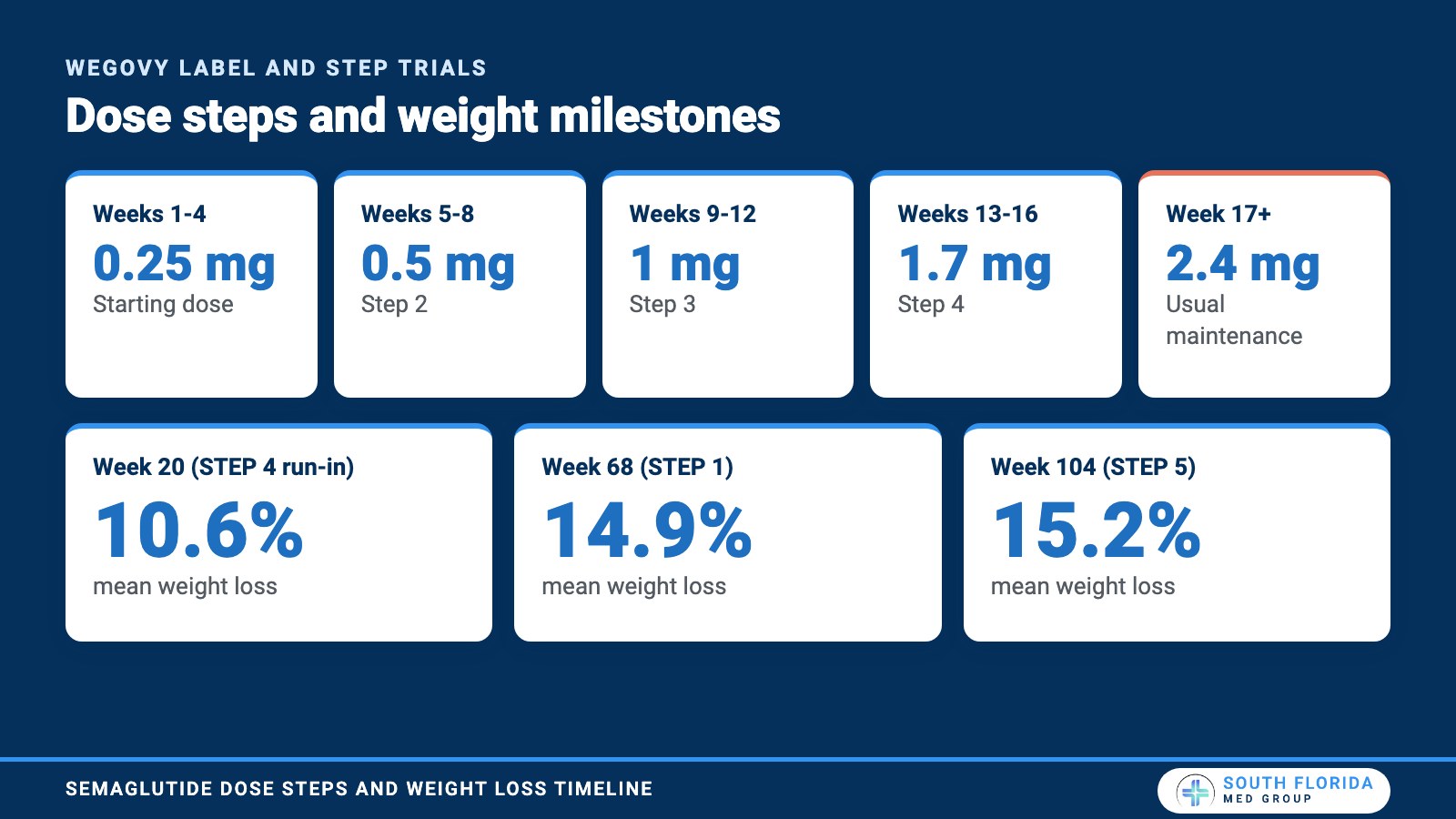
Semaglutide weight loss by week starts slowly because the Wegovy label begins at 0.25 mg and climbs for 16 weeks. The label states that escalation exists to reduce the risk of gastrointestinal adverse reactions. Weight loss data therefore reflect a rising dose, not a fixed one.
The table lists the label dose steps next to the trial milestones.
| Timing | Label weekly dose | Trial result |
|---|---|---|
| Weeks 1-4 | 0.25 mg | Starting dose |
| Weeks 5-8 | 0.5 mg | Escalation step |
| Weeks 9-12 | 1 mg | Escalation step |
| Weeks 13-16 | 1.7 mg | Escalation step |
| Week 17 onward | Maintenance (usual 2.4 mg) | Maintenance phase |
| Week 20 | Maintenance | Mean loss 10.6% (STEP 4 run-in) |
| Week 68 | Maintenance | Mean loss 14.9% (STEP 1) |
| Week 104 | Maintenance | Mean loss 15.2% (STEP 5) |
The STEP 4 trial reported a mean loss of 10.6% during its 20-week run-in. The STEP 5 trial reported 15.2% at week 104 versus 2.6% on placebo. Loss therefore keeps building after the dose steps end, and the graphic below maps that timeline.
How Much Weight Can You Lose in 1 Month on Semaglutide?
You can expect a smaller drop in month 1 on semaglutide, since the label starting dose is 0.25 mg for weeks 1-4. The trials report totals at weeks 20, 68 and 104. No single monthly number comes from those trials.
A simple average gives context. The 10.6% mean loss over 20 weeks works out to about half a percentage point of body weight per week. That figure is arithmetic on a trial average, not a forecast for month 1.
Individual pace depends on dose step, diet, activity and body size. The pounds-to-percent math in the next section shows how size changes the numbers.
How Long Does It Take to Lose 20 Pounds on Semaglutide?
It takes about 20 weeks on average for a 200-pound adult to lose 20 pounds on semaglutide, if the trial mean applies. Twenty pounds equals 10% of 200 pounds, and the STEP 4 run-in produced a mean loss of 10.6% at week 20. That figure is an average, so some adults reach 10% sooner and others later.
The Wegovy label shows that 66.1% of STEP 1 participants lost at least 10% by week 68. Starting weight changes the pounds, since the same percentage means more pounds at higher weights. A prescriber can set a personal timeline after reviewing your history.
Our weight loss timeline guide covers pacing for all weight-loss approaches, and the next section covers the mechanism behind the pace.
How Does Semaglutide Weight Loss Work?
Semaglutide weight loss works by activating GLP-1 receptors, which lowers appetite and calorie intake. The Wegovy label notes that GLP-1 receptors sit in brain areas involved in appetite regulation. Semaglutide is a GLP-1 receptor agonist, meaning a drug that mimics the natural hormone glucagon-like peptide 1.
The label also states that semaglutide delays gastric emptying, the rate at which the stomach releases food. A slower stomach prolongs fullness after a meal. The label links the weight effect to reduced appetite and lower calorie intake.
The drug changes appetite, so the first noticeable change is a quieter urge to eat, which leads to the next question.
What Do Semaglutide Before and After Results Look Like at 3, 6 and 12 Months?
Semaglutide before and after 3 months results are not reported by the trials. Their weight milestones come at weeks 20, 68 and 104. At month 3, which is week 12, the Wegovy label places a patient on 1 mg weekly. That dose is still below the usual 2.4 mg maintenance dose.
The closest early marker is the 10.6% mean loss at week 20, which falls near month 5. The 6-month and 12-month marks also sit between reported points. Week 68 reports 14.9%, and week 104 reports 15.2%.
Any month-by-month chart therefore interpolates between those anchors. Interpolation helps planning, but it does not replace your own measurements, and the early signs of progress come next.
What Are the First Signs Semaglutide Is Working?
The first signs semaglutide is working are a lower appetite and earlier fullness at meals. The label ties the drug's weight effect to reduced calorie intake driven by appetite changes. Scale changes follow appetite changes, and the early dose steps are small.
Other early signs include smaller portions feeling sufficient and fewer between-meal cravings. Gastrointestinal effects also appear during escalation, and the Wegovy label lists nausea in 44% of treated adults versus 16% on placebo. Our side effect guide explains how providers manage them.
Appetite shifts show up well before visible body changes, which is why photo timelines run behind them.
What Do Semaglutide 6 Week Belly Before and After Photos Show?
Semaglutide 6 week belly before and after photos show an early snapshot taken during dose escalation, not a final result. At six weeks, the Wegovy label schedule places a patient on 0.5 mg after four weeks at 0.25 mg. The trials report no six-week figure, so photo claims about belly size lack trial backing.
Semaglutide lowers total body weight, and the label does not report spot reduction from the belly. A flatter waistline can follow overall weight loss. Waist changes vary from person to person.
Photos taken weeks apart also change with posture, lighting and hydration, so a measurement log carries more weight than a comparison picture.
Are Semaglutide Weight Loss Before and After Pictures Reliable?
Semaglutide weight loss before and after pictures are not reliable predictors, because each picture shows one person's result. The label shows a spread from under 5% loss to 15% or more across 1,306 treated participants. A selected photo can sit anywhere on that spread.
The pictures also lack context such as starting weight, dose step, diet and time on treatment. Placebo participants also lost weight, with 31.1% reaching 5% loss. Trial percentages give a fairer view than a posted photo.
Pictures say little about body composition, which the next section covers.
What Changes Does Your Body Show Besides the Scale?
Your body shows changes in appetite, clothing fit and body composition besides the scale. The Wegovy label states that semaglutide lowers body weight with greater fat mass loss than lean mass loss. Lean mass includes muscle, so a provider may track strength and waist along with weight.
Trial participants also received a reduced-calorie diet and activity counseling in the label's Studies 2, 3, 5, 7, 8 and 9. Activity counseling recommended at least 150 minutes per week. Loose skin depends on age, genetics and the amount of weight lost, and a provider can discuss options.
Body changes depend on more than the drug, so the next section lists what shapes results.
What Affects Semaglutide Weight Loss Results?
Semaglutide weight loss results depend on dose step, time on treatment, lifestyle support, health conditions and tolerance. The Wegovy label shows that conditions matter. Adults with type 2 diabetes lost 9.6% versus 3.4% on placebo, while adults without diabetes lost 14.9% versus 2.4%.
- Dose step: the label raises the dose every 4 weeks until week 17.
- Lifestyle support: the label's intensive lifestyle study (Study 4) produced 16% loss versus 5.7% on placebo at week 68.
- Health conditions: type 2 diabetes lowered the average loss to 9.6%.
- Tolerance: the label allows delaying escalation by 4 weeks if a dose is not tolerated.
- Consistency: the label advises restarting escalation at a lower dose after 2 or more consecutive missed doses.
The intensive lifestyle study averaged 16% loss, against 14.9% in STEP 1, so structured habits sit beside the drug effect. A weight loss visit reviews these factors together. Weight that does not move leads to the next question.
Why Am I Not Losing Weight on Semaglutide?
You may not be losing weight on semaglutide because you sit on an early dose step or respond less than average. The Wegovy label shows that 16.5% of STEP 1 participants lost less than 5%. Dose steps below maintenance also limit the effect.
A prescriber can review your dose, timing and tolerability. Hormone conditions and other medications can also affect weight, and our hormonal weight barriers article explains the links. A provider decides whether a change is appropriate.
Responses differ between patients, and the choice of medication changes the question.
Is Ozempic the Same as Semaglutide for Weight Loss?
No, Ozempic and Wegovy both contain semaglutide, but the Ozempic label lists type 2 diabetes, not weight loss. The Ozempic label is indicated to improve glycemic control in adults with type 2 diabetes. The Wegovy label is indicated to reduce excess body weight in adults with obesity or overweight plus a comorbidity.
That difference matters for ozempic weight loss injections before and after posts. The weight data here come from Wegovy trials at 2.4 mg. Searches for weight loss injections before and after mix brands, doses and diagnoses. Our semaglutide vs tirzepatide comparison explains how the other major option differs.
Brand differences affect starting doses, and they also affect what happens after treatment ends.
What Happens When You Stop Semaglutide?
Weight returns toward baseline when you stop semaglutide, and STEP 1 participants regained about two-thirds of their lost weight within a year. The STEP 1 extension followed 327 participants for one year after treatment ended. Mean loss was 17.3% at week 68 in that group.
Participants regained 11.6 percentage points by week 120, leaving a net loss of 5.6%. Cardiometabolic improvements also moved back toward baseline. The authors concluded that ongoing treatment is needed to maintain improvements.
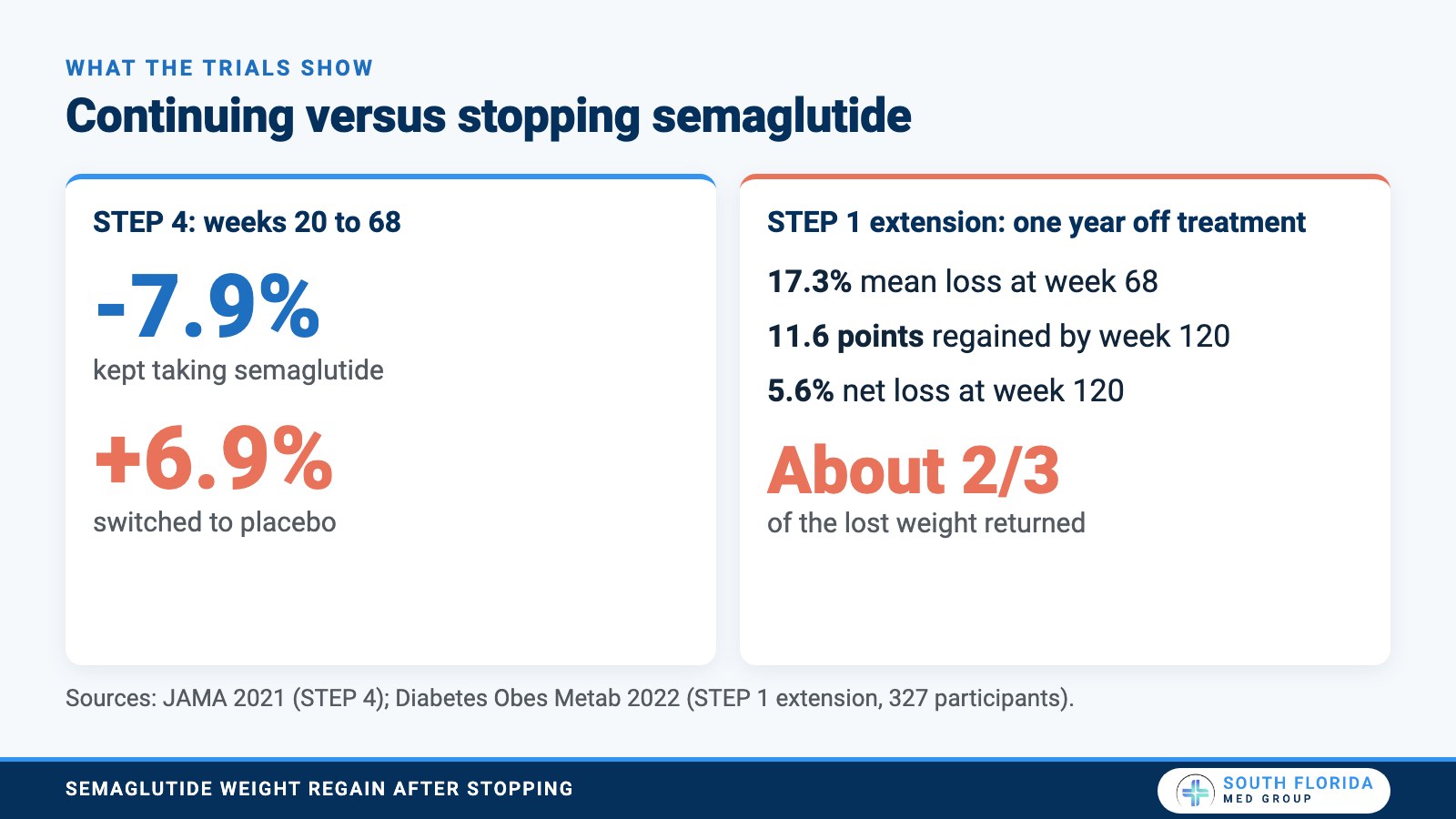
The STEP 4 trial points the same direction. Participants who continued semaglutide changed by -7.9% from week 20 to week 68, while those switched to placebo changed by +6.9%. Talk to your prescriber before any change to your medication.
How to Maintain Weight Loss After Semaglutide?
Plan how to maintain weight loss after semaglutide with your prescriber before the last dose. The trials show regain after withdrawal. The STEP 1 extension shows regain of 11.6 percentage points in one year. A planned transition can address appetite and routine together.
Maintaining weight loss after semaglutide usually involves a written plan. The steps below organize that plan.
- Book a visit with your prescriber before changing the medication.
- Agree on a target weight range and a check-in schedule.
- Set a protein and meal plan with your provider.
- Keep resistance and walking activity on a weekly schedule.
- Weigh in on a fixed schedule and report changes early.
The trials did not test these specific habits, so the steps are planning tools, not proven guarantees. Our weight loss expectations guide helps set a realistic range, and the long-term question follows.
Do You Have to Stay on a GLP-1 Forever?
You do not have to stay on a GLP-1 forever by rule. The STEP 1 extension authors concluded that ongoing treatment is needed to maintain improvements. Weight returned toward baseline after withdrawal in that trial. The Wegovy label describes the indication as maintaining weight reduction long term.
The decision belongs to you and your prescriber, who weigh results, side effects and goals. The STEP 5 trial shows loss held at 15.2% through 104 weeks while treatment continued. Safety over that period is the next question.
Is Semaglutide Safe for Long-Term Use?
Semaglutide is studied for long-term use through 104 weeks in the STEP 5 trial, and the FDA label sets clear safety limits. Gastrointestinal events occurred in 82.2% of semaglutide participants versus 53.9% on placebo, mostly mild to moderate. The Wegovy label carries a boxed warning about thyroid C-cell tumors found in rodents.
The label lists a personal or family history of medullary thyroid carcinoma or multiple endocrine neoplasia syndrome type 2 as a contraindication. A medical history review comes first. A baseline checkup can document that history.
What Else Should You Know About Semaglutide Results?
What Are the Different Doses of Semaglutide for Weight Loss?
The Wegovy label lists weekly steps of 0.25, 0.5, 1 and 1.7 mg. Maintenance is then 1.7 mg or 2.4 mg. The label recommends 2.4 mg. These are label ranges, not advice. A prescriber sets your dose, and our titration schedule post explains each step.
Is 2.5 mg of Semaglutide a Lot for Weight Loss?
A 2.5 mg weekly amount sits close to the label's usual 2.4 mg maintenance dose, which comes after four escalation steps. The label starts at 0.25 mg for a reason, since escalation lowers gastrointestinal risk. Only your prescriber decides your amount.
What Should I Avoid While Taking Semaglutide?
Avoid skipping your prescriber's guidance on dose steps, and report dehydration from vomiting or diarrhea. The label warns that such dehydration can injure the kidneys. Semaglutide also delays gastric emptying, which can change how oral medicines are absorbed, so tell your provider about every medication.
Why Are People Stopping Wegovy?
People stop Wegovy for reasons that include adverse reactions in the trial data. The label reports permanent discontinuation from adverse reactions in 6.8% of treated patients versus 3.2% on placebo. Gastrointestinal reactions alone caused 4.3% versus 0.7%.
Frequently Asked Questions
How Much Weight Can You Lose in 2 Months on Ozempic?
No trial reports a two-month figure for Ozempic, which is labeled for type 2 diabetes. Wegovy trials report a mean loss of 10.6% at week 20. Two months falls inside the dose escalation period, so results vary.
How Long Does It Take to See Weight Loss With Ozempic?
Weight loss with Ozempic can begin in the first weeks, but the label does not state a timeline for weight. Wegovy trials show a mean loss of 10.6% by week 20. A prescriber can explain what to expect on your dose step.
Can You Take Semaglutide for Weight Loss?
Yes, adults with obesity can take semaglutide for weight loss under a prescription. The Wegovy label also covers adults with overweight plus one weight-related condition. A prescriber checks contraindications, such as a history of medullary thyroid carcinoma.
Is Semaglutide a Weight Loss Injection?
Semaglutide is a once-weekly subcutaneous injection, and the Wegovy brand is labeled for weight reduction. The Ozempic brand is labeled for type 2 diabetes. Both contain the same drug, semaglutide.
Does Semaglutide Cause Weight Gain?
No, semaglutide lowers weight in trials, but weight rises again after treatment stops. STEP 1 extension participants regained 11.6 percentage points within a year. Stopping and restarting plans belong with a prescriber.
How Does South Florida Med Group Help With Semaglutide Weight Loss?
South Florida Med Group helps adults review semaglutide weight loss before and after expectations with Stephanie Cabrera, DNP, PMHNP-BC, FNP-BC. We assess health history, medications and goals before any GLP-1 medication is considered. We offer in-person and telehealth visits at our Hialeah office, listed as Miami Lakes.
New patients can start with the first appointment process. That visit covers your history, current medications and goals. A prescription decision comes only after that review, and results from trials guide the discussion.
Weight follow-up checks can run as remote follow-up care between in-person visits. Telehealth suits check-ins on appetite, side effects and routine. Measurements can be shared during the call, so progress stays documented.
A review of your current prescriptions belongs in medication review visits before and during treatment. Semaglutide delays gastric emptying, so other medicines need a second look. Your provider checks interactions and timing. Any dose change also gets documented, so every visit starts from the same record of your current regimen.
Our GLP-1 care includes medications such as semaglutide only when clinically appropriate.
Each plan starts with a review of history, medications and goals, and each result is measured against your own baseline. Trial averages give context, and your provider explains what they mean for you. Follow-up visits then review dose steps, appetite, side effects and routine. Call (786) 860-8844 to ask about a visit with South Florida Med Group.